
Travel guide · Cruises & Tours
Galápagos cruise vs land-based: which is right for you?
Cruise vs land-based Galápagos, compared without the sales pitch: costs, comfort, wildlife access, seasickness, flexibility and who each style actually fits…
 Photo: David Brito
Picture the two evenings. On one, you fall asleep to the engine’s hum and wake up forty miles away, the day’s trail already visible through the porthole. On the other, you fall asleep in a hotel in Puerto Ayora, wake to roosters and coffee, and drive forty minutes past tortoises in the highlands to a dock where the day boat leaves. Same islands, same animals, two very different trips.
Every Galápagos trip starts with the same fork in the road: sleep on a boat that moves every night, or sleep on an island and tour by day. We sell both, so consider this the least conflicted comparison you will read. The honest answer is that neither is “the best way”; each fits a different traveller, and the wrong choice usually comes from booking whichever one was explained to you first.
What a cruise actually is
The classic Galápagos cruise is a small boat, most carry 16 guests, that never returns to port. You board at Baltra or San Cristóbal and sail a fixed itinerary approved by the park. Days run on rails: early landing at a visitor site with your naturalist guide, a walk, a snorkel, back aboard, sail to the next site while you eat, repeat. Larger vessels (up to 100+ passengers) run the same model with more onboard amenities; dive live-aboards do the same for divers, heading to Darwin and Wolf.
The upsides are real:
- Access. The remote sites, Fernandina, western Isabela, Genovesa, the far north, are only reachable by boat, because the public ferries do not go there and day tours cannot reach them within park visiting hours.
- Efficiency. You wake up already at the next site. No daily transfers, no ferry logistics, no packing-unpacking.
- Depth of guiding. Naturalist guides live aboard, and evening briefings mean you understand what you saw the next day.
- Predictability. One price covers cabin, all meals, guided excursions and transfers from the airport.
The downsides, plainly stated: you are locked to a fixed route and schedule; you share roughly 90 square metres of deck with 15 strangers for days; motion is constant (the channel crossings can be rough, especially in the dry season); and the entry price is the highest of any travel style. Budget cruises are the most spartan accommodation you will accept anywhere at their price point.
A note on seasickness, because it decides this choice for more travellers than any itinerary does. The open-water legs between islands are rougher from July to November, when the Humboldt current stirs up the channels, and land travellers feel the same water on the public ferries, so this is not a cruise-only problem. If you cruise anyway, catamarans feel steadier than single-hull boats, mid-ship cabins move less than forward ones, and the warm-season months are kindest to sensitive stomachs.
What land-based actually is
Land-based means hotels in the inhabited islands: Puerto Ayora on Santa Cruz, Puerto Baquerizo Moreno on San Cristóbal, Puerto Villamil on Isabela. Your days mix three ingredients: day tours by speedboat to sites like Bartolomé, Santa Fe, South Plaza or Kicker Rock; free sites you reach independently (Tortuga Bay, Las Grietas, the Puerto Villamil wetlands); and downtime you control.
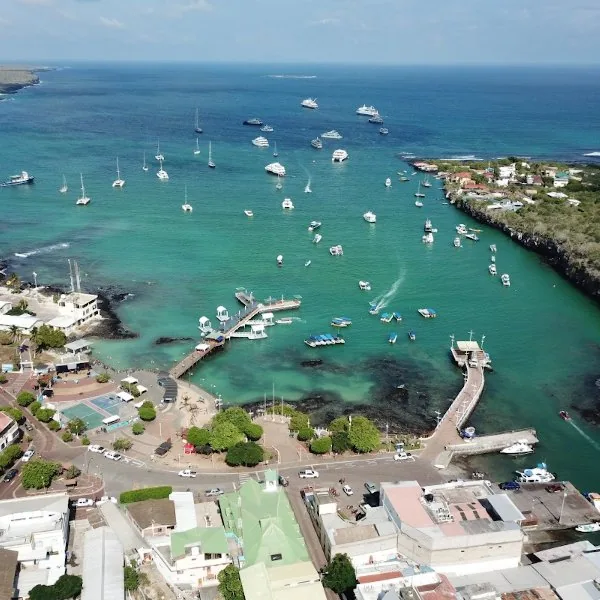
The upsides:
- Flexibility. Change plans mid-trip, stay longer on an island you love, skip a day entirely.
- Comfort per dollar. A decent hotel room with space to spread out, plus dinner choices, costs less than a mid-range cruise cabin.
- Control of pace. Good for families with small children, divers who want fewer days on a boat, and anyone who hates schedules.
- Budget floor. A determined traveller can do Galápagos for considerably less per day than any cruise.
The downsides, equally real: you lose access to the remote islands; day-tour boats are more exposed to weather cancellations; you repeat transfers to the harbour daily; hotel quality varies enormously and the good ones book out in high season; and the logistics (ferries, water taxis, bookings) land on you. And the ferry time adds up: 2 to 2.5 hours per inter-island leg, with a real seasickness factor on the afternoon runs.
Cost, side by side
A few reference points from our budget breakdown: the fixed costs ($20 TCT, $200 park fee, flights at 400-550 USD round trip) are identical either way. After that, cruise prices span an enormous range depending on the boat class, and land trips scale from hostel-plus-day-tours up to luxury lodges. Season moves both numbers: September to November is when boats discount and some sit in dry dock, while Christmas and July-August command the top of every price list. Land-based trips have grown far faster than cruises in recent years (roughly 48% growth versus 16% for cruises in recent industry reports), which tells you where most travellers land. Neither is “cheaper” in the absolute; each has a floor and a ceiling. What we can say plainly: at the low end, land wins. At the high end, a top cruise is hard to beat for what it includes.
Who should pick a cruise
- First-timers who want maximum wildlife diversity in limited days.
- Anyone dreaming of the remote west or north, since those islands have no hotels.
- Travellers who value being looked after: one booking, everything handled.
- Photographers and divers who want repeated access to remote sites.
- People who have never slept on a boat and want to find out, in the most scenic classroom on earth.
Who should pick land-based
- Families with young kids, who need space, pools and schedule breaks.
- Divers and snorkellers on a budget, who can day-trip to excellent sites from all three inhabited islands.
- Anyone who gets seasick, or is pregnant, or simply sleeps badly on boats.
- Travellers combining Galápagos with more of Ecuador on a longer trip.
- People who want free days: reading on a beach, a slow lunch, a surf lesson.
The hybrid: what we recommend to most guests
If you have 7 days or more, the strongest trip is often both: a 4 to 6-day cruise covering the remote islands, then 2 to 3 land-based days on Santa Cruz or Isabela for the free sites, the highlands, and the option to do nothing for an afternoon. You pay the cruise premium only for the part where it genuinely earns it, and you get the island life too.
Frequently asked questions
Which islands can I only see on a cruise?
Fernandina, the western coast of Isabela, Genovesa, Española on most days, and the far-north dive islands of Darwin and Wolf. The public ferries only connect Santa Cruz, San Cristóbal, Isabela and Floreana.
Is a land-based trip much cheaper than a cruise?
At the low end, yes: hostels, free sites and one or two day tours can keep a week under US$2,000 per person including flights and fees. Mid-range land trips and mid-range cruises overlap in price; at the top, luxury lodges and luxury yachts both cost cruise money.
What is the hybrid trip?
A 4- to 6-day cruise for the remote islands followed by two or three hotel days on Santa Cruz or Isabela for the free sites, the highlands and rest. It is what we recommend to most guests with a week or more.
Sources
- Special Regulation for Tourism in Protected Areas (RETANP), Ministry of Environment (PDF)
- Galápagos National Park entry fee table, Galápagos Government Council
- Inter-island ferry fares from 11 August 2026 (Ministry of Transport resolution), Bitácora EC
- Visitor sites of the Galápagos National Park, Galápagos National Park Directorate
Last verified: October 2026
After the islands, the cloud forest: Las Terrazas de Dana Boutique Lodge & Spa, Mindo Cloud Forest, included with every cruise we book.