
Travel guide · Cruises & Tours
Galápagos cruise costs explained, layer by layer
What a Galápagos cruise really costs, layer by layer: real fares per night by class, flights, the park fee and TCT, tips, drinks, wetsuits, the hotel night…
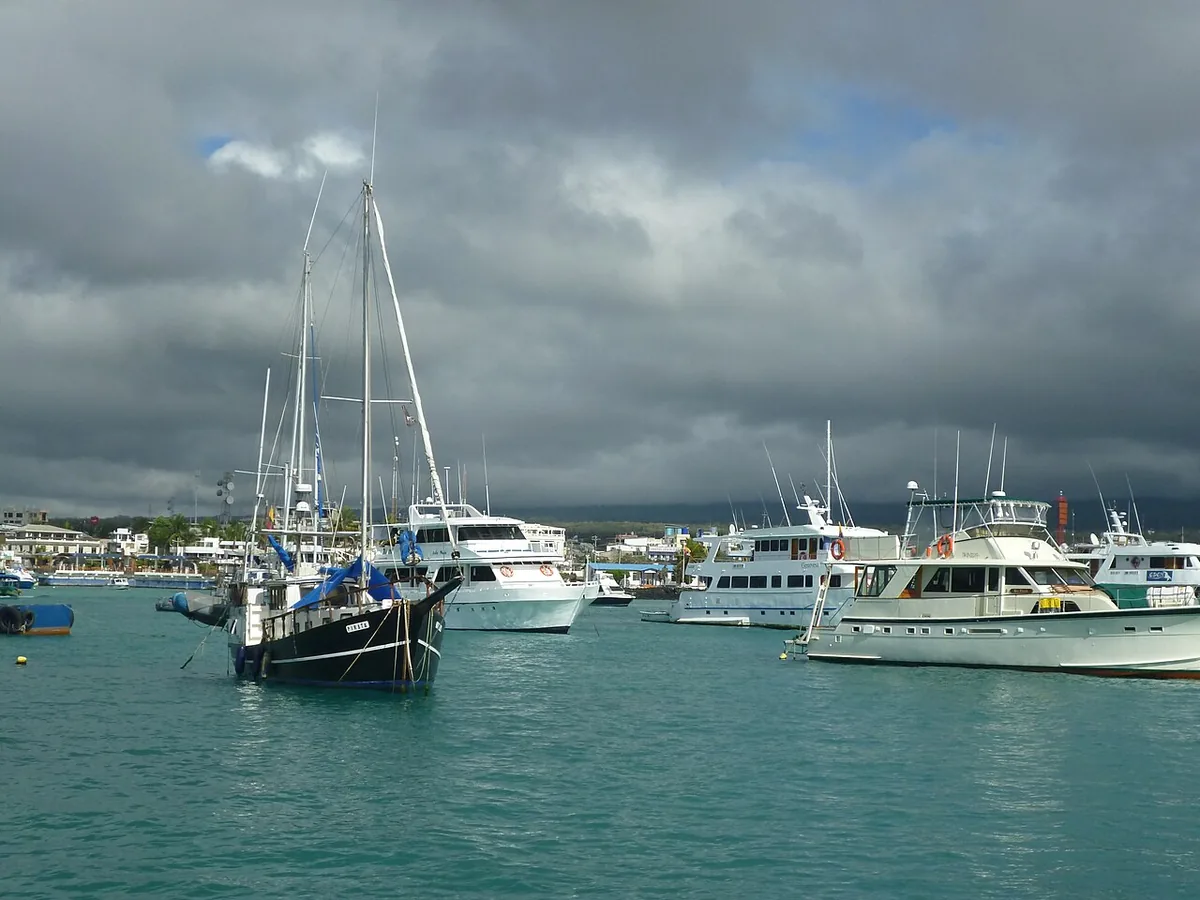 Photo: David Adam Kess (CC BY-SA 3.0) via Wikimedia Commons
The cruise quote is only part of the bill. Travellers who compare a cruise price against a land-based trip’s hotels-and-tours total usually miscount both, because Galápagos costs stack in layers: the yacht, the fixed fees, the flights, the tips and the things nobody puts on the quote. This page itemises every layer, with the real fares of the 30 yachts we book as of October 2026.
Layer 1: the cruise itself
Fares swing more by class and season than by length. Published fares per person per night, in a shared cabin, across every departure in our live schedule:
| Class | Published fare per night | What the class means |
|---|---|---|
| Mid-range | US$650–1,150, median US$780 | Renovated 16-passenger yachts with private bathrooms; the cheapest boats we book |
| First class | US$475–1,540, median US$1,030 | Modern yachts and catamarans with larger cabins; where most of our guests sail |
| Luxury | US$605–2,900, median US$1,460 | Designer catamarans, classic yachts and small ships, often with two guides |
Whole cruises, per person, before any reduction:
| Length | From | Median | Up to |
|---|---|---|---|
| 3 nights | US$1,422 | US$3,245 | US$8,695 |
| 4 nights | US$1,997 | US$4,600 | US$11,350 |
| 7 nights | US$4,140 | US$7,345 | US$19,464 |
Economy-class boats, which we do not book, sail below these lines at US$250–430 per night; the reasons are in our budget cruises guide. What moves the number inside a class: cabin deck and size (lower decks cost less), single supplements, and the month (September cheapest, August and Christmas dearest). Reduced last-minute fares currently apply to 315 departures, with savings of up to 50%.
What the fare includes: the cabin, all meals on board, every guided excursion with a naturalist, snorkel gear on most yachts, and transfers between the airport and the yacht. What it does not include: everything below.
Layer 2: the fixed fees
| Fee | Amount | Where |
|---|---|---|
| National park entry | US$200 per foreign adult, US$100 per child under 12 | Cash, on arrival at Baltra or San Cristóbal |
| TCT transit card | US$20 per person, children included | Online, before your flight |
| Isabela arrival fee | US$10 for foreigners | Only if you also visit Isabela by ferry |
The two everyone pays add US$220 per adult and US$120 per child. They are fixed by law and never discounted; the detail is in our entry fee guide.
Layer 3: flights
Round trips from Quito or Guayaquil run US$400–550 per foreign traveller, more at Christmas and in July–August. Two details catch people: the cheapest published fares are often resident fares that foreigners cannot use, and the flights are rarely discounted close to departure, unlike the cruise. Budget US$500 per person and you will seldom be surprised. The airport choice is in Baltra vs San Cristóbal.
Layer 4: tips
Expected, voluntary, and higher than on the mainland because island living costs more: about US$10–20 per guest per day for the naturalist guide and the same again for the crew, pooled. A couple on a 7-night cruise should budget US$300–550 in tips. Envelopes are handed over on the last evening; some yachts accept cards for tips, most prefer cash.
Layer 5: the costs that hide
- The hotel night before the cruise. Flights from the mainland land late morning and yachts board at midday, which works, but most travellers need a night in Quito or Guayaquil before the flight and sometimes one after. Operators call it the most underestimated line in the budget.
- Drinks. Most yachts charge for alcohol and soft drinks; a few include wine with dinner, and a handful include everything. Ask.
- Wetsuits. Included on most first-class and luxury yachts, US$5–10 per day on some mid-range boats, and worth it from June to November.
- Wi-Fi. Less of a cost every year: many yachts now carry satellite internet and include it, a few still charge per device, and a few have none. If it matters, check the specific boat.
- Kayaks and paddleboards. Included on most catamarans and luxury yachts; paid extras or absent on others.
- Single supplement. Fares are per person in a double cabin; solo travellers pay a supplement unless the yacht has single cabins or waives it close to departure.
- Travel insurance. Not optional for a remote destination; our insurance guide explains what to cover.
- Land days. Pre- or post-cruise nights in the islands, if you add them, and the Mindo stay on the mainland, which with us is complimentary (see below).
The all-in totals
Per person, in a double cabin, including the cruise, flights, the park fee, the TCT and tips; excluding international flights, mainland hotel nights, insurance and drinks:
| 4 nights | 7 nights | |
|---|---|---|
| Mid-range yacht | about US$3,000–4,500 | about US$5,000–7,500 |
| First-class yacht | about US$4,500–6,500 | about US$7,000–9,500 |
| Luxury yacht | about US$6,000–9,000 | about US$9,000–14,000, and beyond on the top suites |
If a quote looks dramatically under these lines, it is a per-person “from” price for the smallest cabin in the lowest month, or an economy boat.
What is free: the Mindo stay
Every cruise booked with us includes a stay at Las Terrazas de Dana Boutique Lodge & Spa in Mindo Cloud Forest, two hours from Quito: complimentary nights (usually two or three, more on request), all meals and private transfers from and to Quito. Fares of US$3,500 or more per person add tickets for the activities (Mindo Plus), and fares of US$5,000 or more add a private guide throughout and private transport to everything (Mindo All-Inclusive). Against mainland hotel nights at US$150–300, it is the one line in this budget that goes the other way; the complimentary nights guide explains it.
How to pay less without gambling
- Travel in September, the year’s price floor, or in the shoulders of May and October–November.
- Choose first class over luxury unless the two-guide ratio is the point; choose mid-range over economy always.
- Take the lower-deck cabin.
- Watch the last-minute window if your dates float: the mechanics are in last-minute cruises.
- Book the flights with the cruise, early, since they only get dearer.
Frequently asked questions
How much does a Galápagos cruise cost per person?
On published fares, from US$1,997 for 4 nights and US$4,140 for 7 nights on the yachts we book, with medians of US$4,600 and US$7,345. Add about US$800–1,100 for flights, fees and tips.
What is included in a Galápagos cruise price?
The cabin, all meals on board, every guided excursion, snorkel gear on most yachts and transfers between the airport and the boat. Flights, the park fee, the TCT, tips, drinks and, on some boats, wetsuits are extra.
How much should I tip on a Galápagos cruise?
About US$10–20 per guest per day for the guide and the same for the crew, pooled. Budget US$300–550 per couple for a week.
Is the park fee included in cruise prices?
Almost never. The US$200 park fee and the US$20 TCT card are paid by each traveller, in cash at the airport and online before the flight respectively.
Are Galápagos cruises cheaper last minute?
Often: operators reduce unsold cabins inside 90 days, and the deepest cuts come 30 to 60 days out. Flights and fees never get cheaper, so the saving on the whole trip is smaller than the headline discount.
Related reading
The class-by-class view is in budget cruises and luxury cruises; the whole-trip budget, land-based included, is in what a Galápagos trip really costs; and the decision itself is in how to choose a Galápagos cruise.
Sources
- Live cruise fares, every departure we book, Galapagos Dana Tours
- Galápagos National Park entry fee, Galápagos Government Council
- TCT questions and answers, Galápagos Government Council
Last verified: October 2026
After the islands, the cloud forest: Las Terrazas de Dana Boutique Lodge & Spa, Mindo Cloud Forest, included with every cruise we book.