
Travel guide · Cruises & Tours
Galápagos cruise itineraries explained: routes, days and islands
How Galápagos cruise itineraries really work: the park's 15-day rotation, why every yacht runs two or more routes, what 3, 4, 5 and 7 nights can cover,…
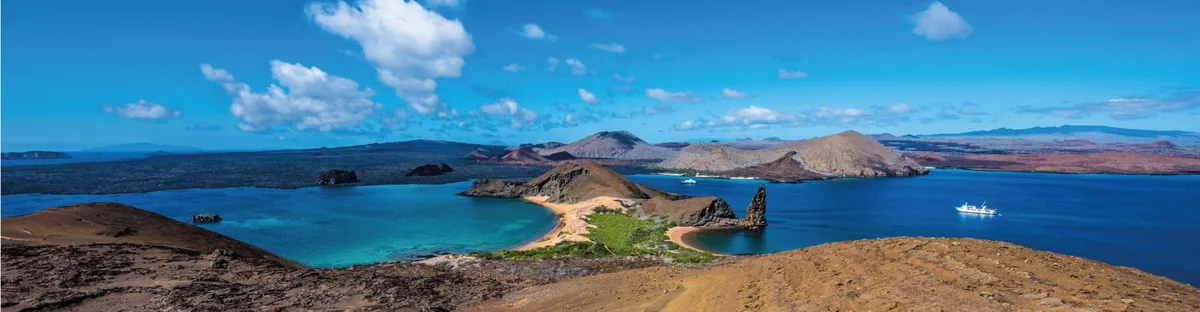
 Photo: Murray Foubister (CC BY-SA 2.0) via Wikimedia Commons
Nobody explains cruise itineraries well, which is odd, because the itinerary is the most consequential choice after the budget. Yachts advertise “Itinerary A” and “Itinerary B”, “North” and “West”, 4-night and 7-night versions that look interchangeable in a brochure and are not. This page gives you the logic: why every yacht runs more than one route, which islands cluster together, what each length can cover, and how to match a route to the animals you came for.
Why every yacht runs two or more routes
Since 2012 the Galápagos National Park has run cruise itineraries on a 15-day cycle: each licensed yacht has an approved 15-day programme, and it may visit a given visitor site only once in those 15 days. The cycle is sold in pieces, which is why a yacht offers, say, a 7-night “A” and a 7-night “B” that together make the 15 days, or 3-, 4- and 5-night segments that fit inside them. The rule spreads the fleet across the archipelago’s visitor sites and stops everyone anchoring at Bartolomé on the same morning.
Three consequences for you:
- The route names are the operator’s, not the park’s. One yacht’s “A” is another’s “North” or “Itinerary 2”. Read the day-by-day, never the letter.
- Two consecutive departures of the same yacht visit different islands. If the island you want is on the other half of the cycle, change dates or change yachts.
- The itinerary you buy is the itinerary you get. Routes are approved in advance and yachts do not improvise, which is also why a cheap yacht’s Española landing is the same trail as an expensive one’s.
The geography: four regions and a hub
| Region | Islands and sites | What it delivers | Season note |
|---|---|---|---|
| The centre, the hub | Santa Cruz, Baltra, North Seymour, Mosquera, Santa Fe, South Plaza, Bartolomé, Santiago’s east coast | Boobies, frigatebirds, land iguanas, sea lions, Pinnacle Rock, the tortoise highlands | Any month; most routes pass through it because of the airport |
| The south and east | Española, Floreana, San Cristóbal | The waved albatross, Gardner Bay, Post Office Bay, Devil’s Crown, Kicker Rock | Albatross April to December; calmest seas December to May |
| The west | Isabela’s west coast, Fernandina | Penguins, flightless cormorants, marine iguana megacolonies, whales, the youngest lava | Richest June to November, when the cold water is up |
| The north | Genovesa, with Santiago and Rábida on the way | Red-footed boobies, storm petrels, owls by day, the nocturnal gull | Frigatebird displays March to June; the longest overnight sail |
In our live schedule, 1,082 departures reach Española, 983 reach Genovesa, 934 include Isabela and 916 Fernandina, 1,073 Floreana and 960 North Seymour. The cruise finder filters by island, which is the fastest way to find the departures that visit the one you care about.
What no route combines in under seven nights: Española in the south-east and Fernandina in the far west. They sit at opposite ends of the archipelago with a long open-water sail between, which is the whole reason the week-long cruise exists.
What each length can cover
Cruise “days” count the arrival and the departure day, so an “8-day cruise” is 7 nights and six full days of visits; “5 days” is 4 nights and three full days. Our yachts sell segments of 3, 4, 5, 6, 7, 8, 10, 11 and 14 nights.
| Nights | Full days | What fits | Who it suits |
|---|---|---|---|
| 3 | 2 | The centre plus one neighbour: Seymour, Bartolomé or Santa Fe, and the highlands | Travellers adding a taste of the yacht to a land trip |
| 4 | 3 | One region done properly: the south-east with Española and Floreana, or the north with Genovesa, or the west | The best value in the market; from US$1,997 per person |
| 5 | 4 | One region plus an extra day: the west with Fernandina and two days of Isabela’s coast, or the south-east with San Cristóbal | First-timers with limited days |
| 7 | 6 | Two regions: the south-east and the centre, or the west and the north, with most of the headline species | The benchmark; from US$4,140 per person |
| 10–14 | 9–13 | Three or four regions, usually sold as two consecutive segments | Birders, photographers and second-time visitors |
Two corollaries. A 4-night south-east loop in May, with the albatross dancing and the sea flat, is a superb trip, not a lesser version of a week. And a week sold as two halves, A plus B, is exactly that: book one half and you get one loop; price it that way.
Matching the route to your wish list
| You most want | Book | When |
|---|---|---|
| The waved albatross | A route with Española | April to December only |
| Penguins and flightless cormorants | The west: Isabela’s coast and Fernandina | Any month; most active June to November |
| The bird island | A route with Genovesa | Any month; frigatebird pouches March to June |
| Devil’s Crown and Post Office Bay | A route with Floreana | December to May for the calmest water at the Crown |
| Whales and dolphins | The west, in the Bolívar Channel | June to November |
| Hammerheads | Routes that snorkel at Kicker Rock, Gordon Rocks or Genovesa’s cliffs; or a dive boat | Warm season at Kicker Rock; cool season at Genovesa |
| Everything | Seven nights, or two segments | Both halves of the cycle |
How to read a day-by-day
- Day 1 starts at the airport around midday: lunch on board and one afternoon site, usually Las Bachas, Mosquera, Seymour or the highlands.
- The last day is a morning site, often Black Turtle Cove or the Darwin Station, and the airport by late morning.
- Count the full days, not the “days”: that is what you are paying for.
- Check the landing types. “Panga ride” and “no landing” sites (Elizabeth Bay, Punta Vicente Roca, Black Turtle Cove) are visited from the dinghy; “wet landing” means wading ashore.
- Note the long sails. The west, Genovesa and Española each cost a night of navigation, which matters if you are prone to seasickness; the seasickness guide explains which cabins to choose.
How to decide, in order
Decide the animals first (albatross means Española between April and December; penguins and cormorants mean the west; seabirds mean Genovesa), then the length (3–5 nights for one region, 7 for two), then the class of yacht, then the specific boat. That order prevents the most common expensive mistake: falling in love with a yacht and then discovering its route skips the animal you flew here for. Cross-check the season in best time to visit, the prices in cruise costs explained and the rest of the decision in how to choose a Galápagos cruise.
Frequently asked questions
What is the difference between itinerary A and B on a Galápagos cruise?
They are the two halves of a yacht’s 15-day cycle, named by the operator; one usually covers the west or north and the other the south-east, but the letters mean nothing across yachts. Read the day-by-day.
Is an 8-day Galápagos cruise worth it?
If you want two regions and most of the headline species, yes: seven nights is the only length that reliably combines, say, Española and the west. If one region is enough, a 4- or 5-night segment of the same yacht costs little more than half.
Which Galápagos islands can only be visited by cruise?
Española, Genovesa, Fernandina, Santiago, Rábida, Marchena, Isabela’s west coast and the northern islets. Day tours from the towns reach North Seymour, Bartolomé, Santa Fe, South Plaza, Pinzón, Kicker Rock and a few more; the ferries connect only the four inhabited islands.
Can I choose the itinerary of a Galápagos cruise?
You choose a departure, and each departure has a fixed, park-approved route. Since yachts rotate between two or more routes, the date decides the islands; our cruise finder filters departures by island.
How many days do you need to see Genovesa or Española?
Genovesa appears on 4-night northern segments and on most 7-night routes; Española on 4- and 5-night south-eastern segments and most 7-night routes. In our schedule 983 departures reach Genovesa and 1,082 reach Española.
Related reading
The regions island by island are in getting your bearings; the islands that anchor each loop are in the Española, Genovesa, Isabela and Floreana guides; and the length question is in how many days in Galápagos.
Sources
- Live departures and itineraries, Galapagos Dana Tours cruise finder
- Visitor sites, Galápagos National Park Directorate
- Special Regulation for Tourism in Protected Natural Areas (RETANP), Ministry of Environment (PDF)
Last verified: October 2026
After the islands, the cloud forest: Las Terrazas de Dana Boutique Lodge & Spa, Mindo Cloud Forest, included with every cruise we book.