
Travel guide · Planning
Galápagos for Seniors: Pacing, Access and Comfort
How seniors can experience Galápagos comfortably, from cruise cabin choices and easy trails to island day trips, medical prep and honest walking advice.
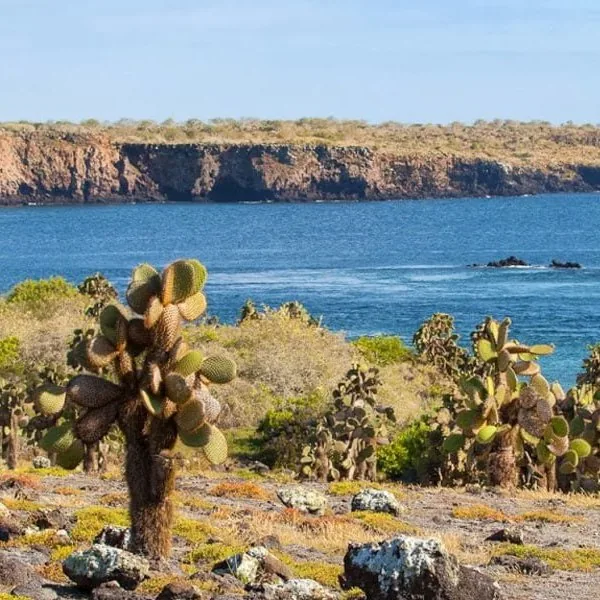
We have hosted travelers in their seventies and eighties who saw more wildlife in four days than most visitors do in a week. Age is not the limiting factor in Galápagos, terrain and pacing are, and both can be planned around. The wildlife does not care how old you are: it sits at two meters either way. Here is what to plan for.
Choose your level of walking realistically
Every visitor site has a marked trail, and trails range from flat boardwalks to lava scrambles. The good news: some of the best wildlife sits at the start of the trails. Sea lion colonies, marine iguanas and flamingo lagoons are often within a few hundred meters of the landing. Talk to your operator before booking and match sites to knees and balance, not to the brochure’s highlight list. A guide who knows you want the short version will keep the group moving at your pace.
Bring real walking shoes with grip for lava rock, and consider a walking stick; guides and boats usually have poles to lend, but asking beats assuming.
The operational rhythm helps too: shore visits run at a walking pace of 2-3 km/h on mostly flat trails, lasting 2-3 hours with regular stops for wildlife and photos, and there is a meal between the morning excursion and the afternoon one. You are never far from a seat, a snack or the boat.
Cruises: what to ask before booking
The boat choice matters more for older travelers than any other factor. The questions that separate a comfortable week from a tiring one:
- Cabin location: lower decks and midship ride more gently, and you feel the overnight navigation less.
- Stabilizers: larger vessels carry them; smaller yachts feel every swell. Ask directly.
- Crew-to-guest ratio and panga assistance: landings are wet or dry, and a steady hand from a crew member is the difference between easy and awkward.
- Itinerary pace: some routes involve more daily landings than others. Fewer, longer visits beat five short hops.
Boats handle accessibility differently, and a few have cabins and doorways that suit limited mobility better than others. Describe your mobility situation to the operator plainly and let them match the vessel. That is literally our job.
Land-based: the flexible alternative
Sleeping ashore every night is the lower-energy version of the trip. You sleep still, eat at ground level, and control every day’s start time. Santa Cruz makes the best base, with its own set of easy highlights: the tortoise reserve in the highlands, the Charles Darwin station’s walkable paths, and the flat lagoon walk at Tortuga Bay. Flights land at Baltra, and the transfer into town is straightforward; where the two airports sit is explained in our airport comparison.

Day boats from the towns reach plenty of wildlife without any camping-out at sea. The tradeoff is that some day trips involve early starts, and a couple of the classic destinations mean longer boat rides; ask which day trips keep the crossing under an hour if that matters to you.
The ferries, and when to skip them
Interisland launches are fast, open boats that take about two to two and a half hours per leg, and they are the most physical part of land-based travel: a pier-to-boat water taxi, a ladder, spray. They run morning and afternoon, and mornings are calmer. If balance or mobility is a concern, either take the morning crossing, book a seat on a larger operator, or reduce yourself to two islands and skip the third. Many travelers finish perfectly happy seeing Santa Cruz and San Cristóbal only, and Isabela’s charm survives without you if the crossings don’t suit.
Health preparation
Bring prescription medications in original packaging with extra days of margin, since refills on the islands are not a sure thing. The inhabited islands have basic hospitals, and serious issues mean evacuation to the mainland, which is precisely why travel insurance with medical evacuation and a 24-hour assistance line is not optional at this end of the age range. Disclose pre-existing conditions when buying, not at claim time. Sun protection is serious business at the equator, whatever your age: hats, cover-ups, reef-safe sunscreen, and water on every excursion.
Motion sickness remedies deserve a test run at home, and a lower cabin or a land-based plan solves most of the problem before it starts.
What seniors consistently love most
After years of watching, the pattern holds: giant tortoises in the highlands, where you walk flat paths through green pasture; the breeding centers, where the story is told at bench speed; and panga rides, which put you at eye level with penguins and frigates without stepping onto rock at all. None of the three requires a scramble, and all three deliver the archipelago’s best.
Tell us your pace, your knees and your wishlist, and we will build the week around the first two.
Frequently asked questions
Is Galápagos suitable for older travellers?
Yes. Age is not the limit; terrain and pacing are, and both can be planned around. Flat trails, breeding centres and panga rides deliver most of the wildlife without scrambling over lava.
What should seniors ask before booking a cruise?
Cabin location (lower decks and midship move less), whether the vessel has stabilisers, how much help the crew gives at landings, and how many landings a day the itinerary includes. Fewer, longer visits beat five short hops.
Should I avoid the inter-island ferries?
Not necessarily, but take the morning crossing, which is calmer, and know they involve a water taxi, a ladder and some spray. Many travellers happily do Santa Cruz and San Cristóbal only and skip the longer Isabela legs.
Sources
- Visiting rules, Galápagos National Park Directorate
- General visiting rules, Resolution 0000007 (Official Register 515), full text (PDF)
- Inter-island ferry routes and timetables, Ferry Galápagos
Last verified: October 2026