
Travel guide · Wildlife
Galápagos flightless cormorant
The world's only flightless cormorant, around 1,600 adults on Fernandina and west Isabela. Where to see it, when it nests, and why it gave up flying.
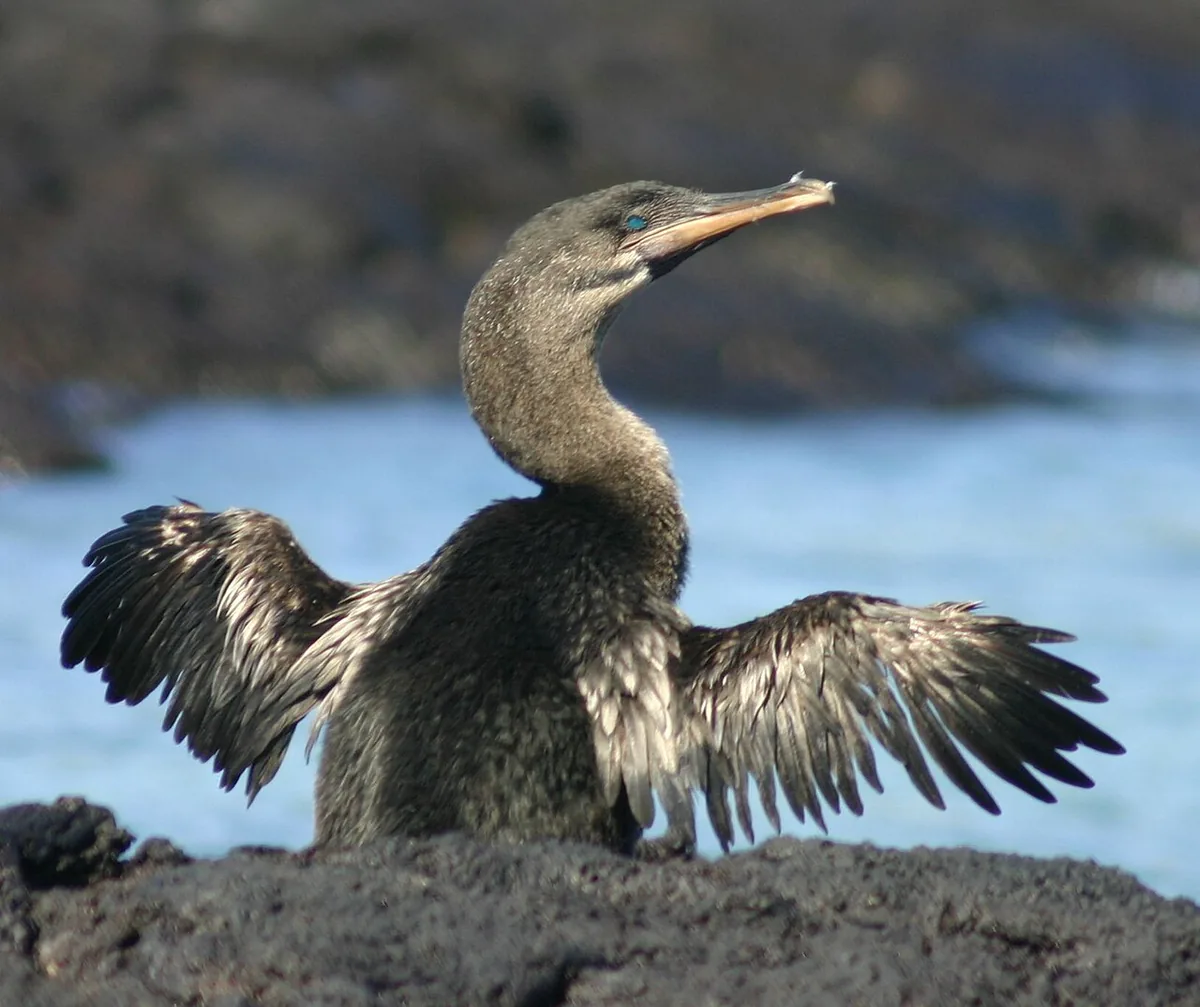 Photo: Charles J. Sharp (CC BY-SA 3.0) via Wikimedia Commons
The only cormorant in the world that cannot fly, and one of the best arguments that evolution happens fast. Over millennia of predator-free, fish-rich coastline, the strongest swimmers out-reproduced the strongest flyers, the wings shrank, and the bird became the heaviest cormorant species. Today roughly 1,600 adults remain, endemic to Fernandina and the coasts of Isabela (galapagos.org). It is a west-island species: put it on your must list and your itinerary will follow.
Where to see them
The population splits between Fernandina and Isabela’s north and west coasts, where the cold upwelling keeps the water food-rich:
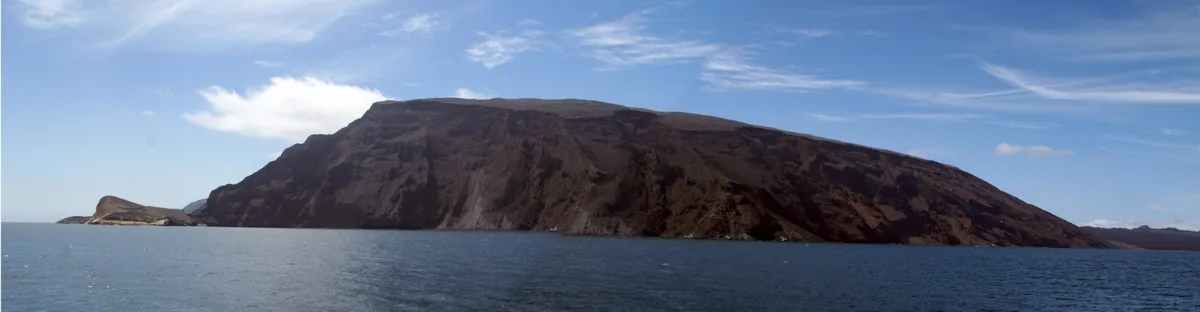
- Fernandina, Punta Espinosa and Punta Mangle. The densest encounters; at Espinosa they nest in seaweed mounds just above the high-water line, a few steps from the sea.
- Isabela. Tagus Cove, Punta Vicente Roca and Elizabeth Bay by panga; Albemarle Point, where nesting sites sit in one of the least-visited corners of the archipelago.
- The Bolívar Channel between Isabela and Fernandina, where the coldest water concentrates their fish.
No land-based day trip reaches them: every reliable site sits on the western itineraries that only cruise boats cover. That logistics split is in our cruise vs land guide.
When to see them
Year-round, since they breed opportunistically, but most eggs are laid between May and October, and courtship is a show worth timing: pairs face each other and turn in a tight circle with their necks intertwined, a dance no other cormorant does. A clutch averages three eggs with about 35 days of incubation, and chicks stay dependent on adults for more than 70 days. El Niño is the recurring catastrophe: the 1982–83 event removed roughly half the population. Recovery is slow because a bird that gave up flight also gave up dispersal, and it can only rebuild where it already lives.
How they live
Males are about 35% heavier than females. The stubby wings are vestigial; swimming comes from the powerful legs and webbed feet, and they hunt bottom fish and octopus in regular dives to 10–15 m, with individuals recorded far deeper. On land they look prehistoric and slightly wrong, holding the wings out to dry like a flag with no wind. Adults make a low, growling call, unusual for a cormorant.
Conservation
Listed as Vulnerable, and the profile is fragile by design: one species, two islands, the smallest range of any cormorant, and total dependence on cold-water upwelling that climate cycles can switch off. Fernandina is the protective miracle: the island has never been colonized by introduced species, which is why its cormorants, penguins and marine iguanas thrive in a way no inhabited island can match. The National Park’s panga-only access rules around nests keep the human footprint small (rules here).
Details worth knowing
- About 1,600 adults in total (galapagos.org, 2026); the Charles Darwin Foundation’s September 2024 census counted 762 individuals across the core colonies, 13% of them juveniles, a ratio stable for four years. Published totals vary by source and by what is counted, so treat any single number as an estimate.
- They nest just above the high-water line because the shortest walk to food is the whole point of their body plan.
- Four toes on each foot, fully webbed; the wings are a display organ now, not an engine.
- The species was reduced and restricted long before tourism; visitors are not the threat, the loss of cold water is.
How a bird gives up flying
Flight is expensive. A cormorant that flies needs big flight muscles, a deep keel on the breastbone and the food to fuel both, and on most coasts it needs them to escape predators and to reach fish that live far from its nest. On Fernandina and western Isabela none of that applied: the fish were a few metres from the shore in the cold upwelling, and nothing on land hunted an adult bird. Over generations, the individuals that invested in legs and body mass instead of wings dived better, raised more chicks, and the wings shrank to about a third of the span a flying cormorant of the same size would carry.
The result is a bird built like a diver and nothing else: dense bones, powerful legs set far back, a heavy body that sinks easily, and the stubby wings held out after a swim in the old drying posture, a reflex that outlived its purpose. It is the same evolutionary bargain the Galápagos giant tortoise and the marine iguana made in their own ways, and the same vulnerability: an animal that cannot leave is at the mercy of whatever arrives.
Frequently asked questions
Where can I see the flightless cormorant?
Only on Fernandina and the north and west coasts of Isabela: Punta Espinosa, Punta Mangle, Tagus Cove, Punta Vicente Roca and Elizabeth Bay. All are cruise sites; no day trip reaches them.
How many flightless cormorants are there?
Roughly 1,600 adults according to galapagos.org, with the Charles Darwin Foundation’s 2024 census counting 762 individuals across the core colonies. The species is listed as Vulnerable.
When do flightless cormorants nest?
Year-round, but most eggs are laid between May and October, which is also when the courtship dance, two birds circling with intertwined necks, is easiest to see.
Sources
- Sea birds of Galápagos, Galápagos Conservancy
- The science behind penguin and cormorant conservation, Charles Darwin Foundation
Last verified: October 2026