
Travel guide · Activities
Kayaking and paddleboarding in Galápagos: where and how
Where you can kayak and paddleboard in Galápagos: the park rules, the best bays and mangroves, cruise boats with boards on deck and rental options from town.
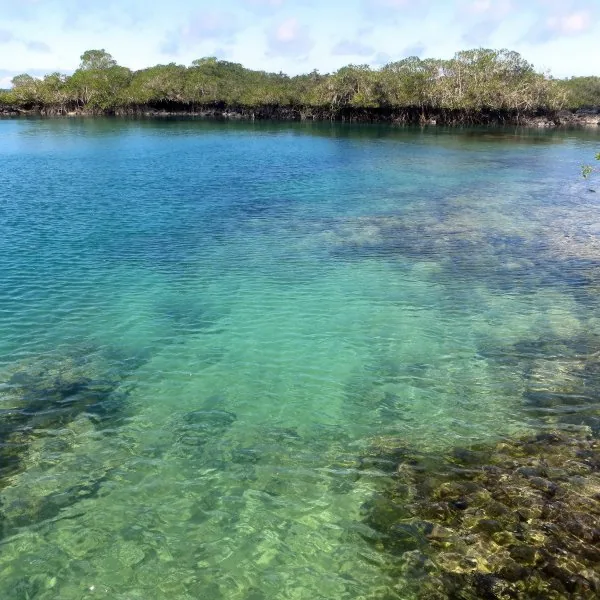
 Photo: Thruxton (CC BY 3.0) via Wikimedia Commons
Kayaks and stand-up paddleboards get you onto the water without a boat ticket, and in Galápagos that means sharing a bay with penguins, sea lions and feeding turtles at your own pace. The catch: the park decides exactly where you may paddle, so the activity runs on permits and site lists, not free roaming. Here is how it works.
The rules first, because they decide everything
Kayaking and SUP are allowed only at designated sites, under the park’s per-site visitor capacity system, in defined time slots. A few specifics worth knowing before you book anything:
- Landings from kayaks are not allowed. The kayak stays on the water; your guide meets you back at the boat or the beach.
- On cruises, the panga (inflatable) escorts kayakers. On day tours, a guide paddles with the group.
- Several sites are explicitly off-limits to kayaks, including Bahía Elizabeth, Bahía Sullivan, Bartolomé and Caleta Tortuga Negra (Black Turtle Cove), where the panga-only rule protects the mangrove channels.
- The general park rules apply on the water: two metres from wildlife, no touching, no feeding, no flash photography.
Where you can actually paddle
- Tortuga Bay (Santa Cruz): the sheltered Playa Mansa lagoon is the classic paddle and snorkel spot, and kayaks rent by the hour on the beach.
- Puerto Ayora bay and the Academy Bay area: easy water right from town.
- Isla Lobos and Kicker Rock (San Cristóbal): Kicker Rock is one of the sites where kayaking is explicitly permitted alongside snorkel and dive boats; Isla Lobos pairs the paddle with its sea lion colony.
- Isabela: the waters off Puerto Villamil and the Tintoreras area see the most paddling; rentals and guided trips operate from town.
- Tagus Cove (Isabela) is a favourite cruise stop where boats historically offered kayak time in the cove, below the whalers’ graffiti.
- Cruises that carry kayaks include several 16-passenger catamarans and yachts (Ocean Spray, Sea Star Journey and Galaxy Sirius among them); if kayaking matters to you, ask which boats carry boards before you book, because not all do.
SUP: same scheme, narrower footprint
Stand-up paddleboarding follows the same permit structure as kayaking, at designated sites with per-slot capacity. It suits the calm-season months (December to May), when the sea is flat and the water clear; in the July–October swell, paddling a board in open water stops being fun. If you have never SUPed before, the calm bays around the inhabited islands are a genuinely good place to learn, with sea lions as an audience.
Costs and logistics
Rental prices for kayaks by the hour are low (a handful of dollars at Tortuga Bay), and guided kayak or SUP tours from the towns run in line with other half-day water tours, from around $80 (check current rates). The cheapest route is often to bring your own packing: a folded towel, dry bag and reef shoes are all you need. On cruises, kayak use is included where the boat carries them, which is the best value: you are already at the bay before breakfast.
When the water is kindest
December to May gives you the calmest seas and the clearest water. November, as the swell settles, is a sleeper pick: visibility improves and sea lion pups, born August–October, are at their most curious. The rough months, July to October, are better for hiking weeks than paddling weeks; see our best time to visit guide for the month-by-month detail.
What you see from a kayak that you miss from a boat
A kayak sits at the height of the animals. Sea lions surface beside the hull and roll under it; marine iguanas swim past at eye level on their way to the algae beds; penguins at Tagus Cove or in the bay off Villamil porpoise around the paddles. Boobies and pelicans dive within metres, because the kayak does not sound like a boat. Along mangrove shorelines at Tortuga Bay or Academy Bay the water is clear enough to watch turtles and rays on the bottom as you drift over them, which no deck gives you.
The pace is the other difference. A panga tour moves at the group’s speed; a kayak moves at yours, and the best moments come from stopping, shipping the paddle and letting the current take you along a wall of lava for ten minutes while things happen around you. Keep the two-metre rule, which in a kayak means not paddling toward animals and letting them close the distance, and keep your eyes on the water as much as the shore: the ray that passes under the hull is the one you remember.
Frequently asked questions
Can I kayak anywhere in Galápagos?
No. Kayaking and SUP are allowed only at designated sites, in time slots with per-site capacity, and some sites such as Elizabeth Bay, Sullivan Bay, Bartolomé and Black Turtle Cove are closed to kayaks entirely.
Where can I rent a kayak in Galápagos?
By the hour at Tortuga Bay on Santa Cruz, and from operators in Puerto Ayora, Puerto Baquerizo Moreno and Puerto Villamil. Several 16-passenger cruise yachts carry kayaks; ask before booking.
When is the best season for paddling?
December to May, when the sea is calm and the water clear. In the July to October swell, open-water paddling stops being fun; November is a quiet, calm pick with playful sea lion pups.
Sources
- General visiting rules, Resolution 0000007 (Official Register 515), full text (PDF)
- Visiting rules, Galápagos National Park Directorate
- Galápagos weather and seasons, International Galápagos Tour Operators Association (IGTOA)
Last verified: October 2026