
Travel guide · Wildlife
Whale shark
Whale sharks in Galápagos: the largest fish in the sea, season June to November at Darwin and Wolf, how to see them, and the spot-pattern census.
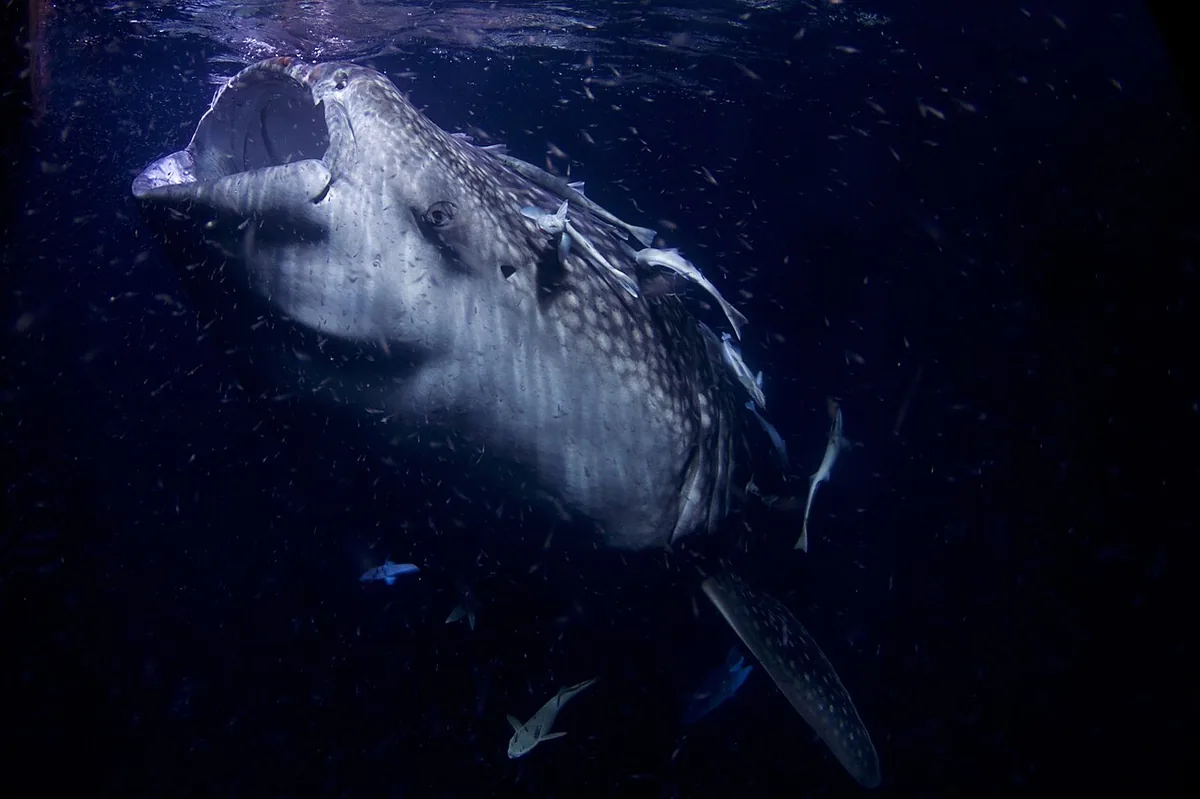 Photo: Arturo de Frias Marques (CC BY-SA 4.0) via Wikimedia Commons
The whale shark is the largest fish alive, it filters plankton, and every dry season a stream of them, almost all enormous pregnant females, passes through the waters off Darwin and Wolf. Seeing one from a dive liveaboard is one of the two or three underwater moments Galápagos can offer that almost nowhere else can. Here is the season, the science, and the honest logistics.
The season and the place
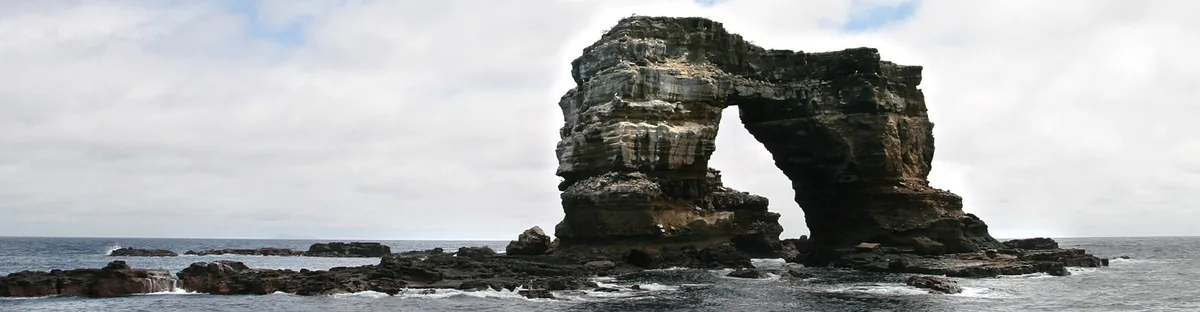
Whale sharks visit the northwest of the archipelago from June to November, peaking with the arrival of the cold Humboldt current. Darwin and Wolf, over 100 miles (160 km) northwest of Isabela, are the core; El Derrumbe (the Landslide) and the sandy slope below the old Darwin’s Arch are the named dive sites. The timing is not a coincidence: sharks ride the Humboldt’s nutrient upwelling, and the numbers of pelagic species in the reserve peak in that same dry season.
How big, and how gentle
A whale shark here can run up to 14 m and 40 tonnes, which makes it the largest fish on Earth. It eats plankton, filtering around 90 lb (40 kg) of it a day through 350 rows of tiny teeth that do nothing at all. It is a regular visitor to the marine reserve, it is classified as Endangered (IUCN, 2016), and its global population is estimated to have fallen by more than 50 percent over the last three generations (about 75 years), driven by fishing and finning outside protected waters.
The pregnancy mystery
One of the strangest facts in marine biology lives here: nearly every whale shark documented at Darwin and Wolf is a mature female, many visibly pregnant, and no one knows where they give birth. One confirmed detail from the research: the largest recorded litter, from a female caught off Taiwan, contained about 300 embryos. The working hypothesis is that the Humboldt upwelling plays a role in their breeding cycle, but reproduction in this species is still largely a mystery.
Two identification tools you can help with as a visitor: the white spot pattern on each shark’s back is unique, like a fingerprint, and photo catalogs use it to track individuals across oceans. Scientists also believe the sharks navigate to Galápagos along geomagnetic pathways, which reads like something a novelist made up and is simply what the tracking shows.
How to see one
There is exactly one honest answer: a week-long dive liveaboard to Darwin and Wolf, between June and November. These itineraries are for experienced divers only: strong currents, deep water, the “Washing Machine” reputation - and they sell out well in advance. From land-based trips, whale shark sightings are luck rather than plan; day boats from Santa Cruz or San Cristóbal rarely reach those waters. If the whale shark is your priority, book the liveaboard first and build the rest of the trip around it.
Snorkelers can still see them in season at the surface, and some liveaboards allow it on the right days; ask before booking, not after. Our hammerhead shark page covers the other big draw at Darwin and Wolf, the sharks guide compares the reef species, and the wildlife calendar maps the season.
What a whale shark encounter is actually like
Whale shark dives at Darwin are drift dives along the slope below the old arch, where the group hooks into the rock at 15 to 25 metres and waits in the current while the hammerheads pass. The whale shark does not come to the divers; the guide watches the blue for a shape, signals, and the group unhooks and swims out to meet it, kicking hard against the current for a minute or two that feels longer. Then the animal is there, a wall of spotted grey moving at walking pace, and for thirty seconds to a few minutes you swim alongside it, usually near the head, before it outpaces you and fades back into the blue. Most encounters are one shark; good days bring three or four in a dive.
Two things make or break it. Air: swimming hard at depth burns gas, so the dive is planned with a wide reserve and the computer is checked constantly. Discipline: the shark leaves if divers crowd its head or touch it, and the guides enforce a few metres of distance and no flash. Done right, it is the encounter people cross the world for, and it is why the liveaboards sell out a year ahead.
Frequently asked questions
When is whale shark season in Galápagos?
June to November at Darwin and Wolf, peaking in August and September when large females aggregate off Darwin.
Can I see whale sharks without diving?
Rarely. They pass the far-northern islands that only dive liveaboards reach. Some liveaboards allow snorkelling with them at the surface on the right days; from land-based trips a sighting is luck.
How big do whale sharks get?
Up to about 14 m and 40 tonnes, the largest fish on earth. They filter plankton and are harmless to people; the species is listed as Endangered.
Sources
- Biodiversity of Galápagos, Galápagos Conservancy
- Special Regulation for Tourism in Protected Areas (RETANP), Ministry of Environment (PDF)
- General visiting rules, Resolution 0000007 (Official Register 515), full text (PDF)
Last verified: October 2026