
Travel guide · Wildlife
Galápagos sharks: whitetip, blacktip, Galápagos and tiger
A single-page comparison of Galápagos' main sharks: whitetip, blacktip, Galápagos and tiger. Where each one lives, when, and how much risk there really…
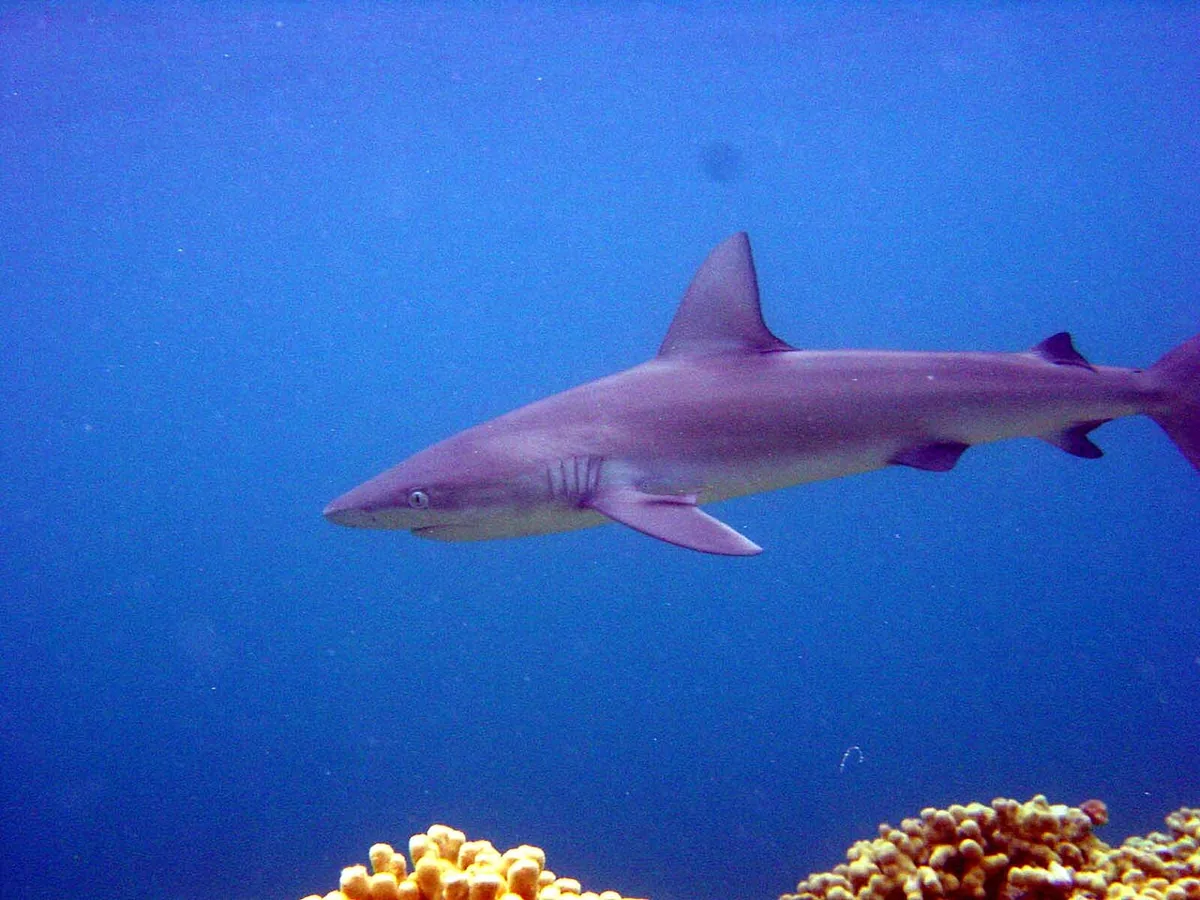 Photo: NOAA (Public domain) via Wikimedia Commons
Sharks are present all around Galápagos all year, and most visitors see several species without ever looking for them. This page puts the four you are most likely to ask about, whitetip reef, blacktip reef, Galápagos shark and tiger shark, side by side, with where each one shows up and the season that matters.
The comparison
| Shark | Size | Where to see it | Season | Status |
|---|---|---|---|---|
| Whitetip reef | Up to ~1.6 m | Los Túneles and Las Tintoreras (Isabela), Puerto Ayora pier at night | Year-round | Near Threatened |
| Blacktip reef | Up to ~2 m | Kicker Rock (snorkel), Gordon Rocks (dive), Puerto Ayora pier at night | Year-round | Near Threatened |
| Galápagos shark | Up to ~3 m | Darwin and Wolf (dive liveaboard); day boats to Gordon Rocks, Beagle, Daphne, Guy Fawkes | Year-round; mating Jan-Mar | Least Concern |
| Tiger shark | Over 5 m | Darwin and Wolf; Canal de Itabaca between Santa Cruz and Baltra | Most often Feb-Jun | Near Threatened |
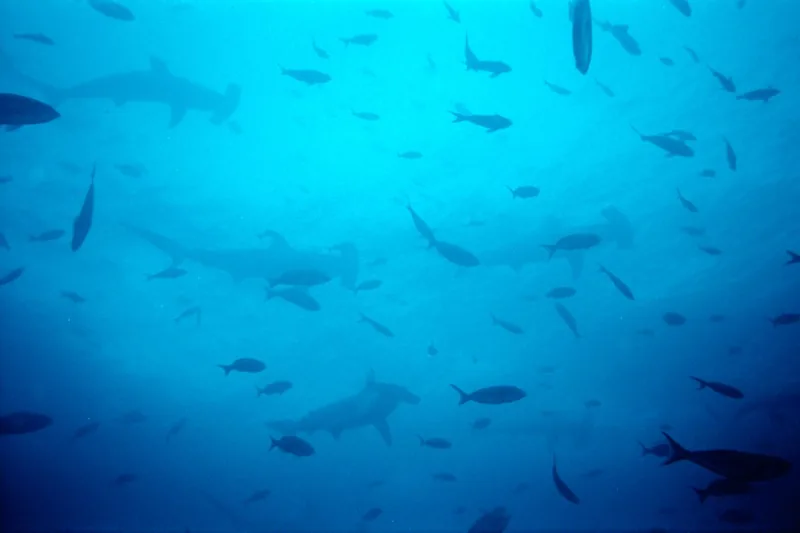
Two more you will hear about on liveaboards: silky sharks, smooth-skinned and curious, often near the surface; and the scalloped hammerhead, which has its own page because it is the headline act, and because its global IUCN status, Critically Endangered (2020), is the worst of any shark here.
Whitetip reef shark: the one sleeping under the ledge
The most common shark in Galápagos. It rarely exceeds 1.6 m, rests on the bottom during the day pumping water over its gills (the one shark you will see motionless) and hunts at night for octopus, crustaceans and fish. Females mate with up to five males, gestation runs 10-12 months, and pups are born around half a meter long. In the water they are harmless and lazy by day; the only drama is courtship, where males bite females’ fins.
Best sites: Los Túneles and the Tintoreras channel on Isabela, both by snorkel, plus the Puerto Ayora pier after dark, where the dock lights draw fish and the sharks follow.
Blacktip reef shark: the one patrolling the shallows
The one you see finning in ankle-deep water. It grows to about 2 m and 60-100 kg, needs to keep swimming to breathe, and hunts small fish in loose groups at night; fish make up about 90 percent of its diet. Mangroves are its nursery habitat, and it matures at 4-5 years. Kicker Rock is the most reliable snorkel site; Gordon Rocks for divers; the Puerto Ayora pier at night works again.
Galápagos shark: the open-water bruiser
Up to 3 m and around 195 kg, with 14 rows of teeth. Despite the name it is not endemic (it is a tropical-ocean wanderer found worldwide), but Galápagos is where you see it reliably, mostly at Darwin and Wolf on dive liveaboards, usually patrolling deeper than 30 m where it hunts bottom fish, octopus and the occasional sea lion. Mating runs January to March, pups arrive in shallow nurseries by April-May, and litters run 4-16 live young. In a nice bit of symmetry, the species is listed as Least Concern, the best status of any shark here.
Tiger shark: the rare winter guest
The heavyweight, over 5 m and up to 2,000 lb (900 kg), and the fourth-largest shark in the ocean, able to burst up to 20 mph (32 km/h). It shows up mostly in February to June, in the warmer water, following the green turtle nesting season; tigers eat turtles, and the diet is the broadest of any shark. Sightings happen at Darwin and Wolf and in the Canal de Itabaca. The National Park and the Charles Darwin Foundation run a tagging program: a tiger named Yolanda was tracked 600 miles (1,000 km) from Galápagos to Cocos Island, Costa Rica, proof of how connected these marine reserves are.
Risk, in numbers
The recorded incident count in Galápagos since 1854 is a handful, none fatal; one serious, non-fatal bite on a diver was reported in 2026. The odds of a fatal unprovoked attack here are vanishingly small, and the species you will actually share water with, whitetips and blacktips, are not interested in people. Meanwhile the pressure runs the other way: humans kill an estimated 100 million sharks a year worldwide, and the reserve here is one of their safer homes.
If the big animals are the reason for your trip, read our hammerhead shark and whale shark pages, and the rays of Galápagos for the flat section of the cast. Month by month, the wildlife calendar has the detail.
Frequently asked questions
Is it safe to snorkel with sharks in Galápagos?
Yes. The species you meet while snorkelling, whitetip and blacktip reef sharks, ignore people. Only a handful of incidents have been recorded since 1854, none fatal; the hazard in these waters is current.
Which shark will I most likely see?
The whitetip reef shark, resting motionless on the bottom by day at Los Túneles, Las Tintoreras and under the Puerto Ayora pier at night. Blacktips patrol the shallows at Kicker Rock.
Where can I see tiger sharks in Galápagos?
Darwin and Wolf and the Itabaca channel between Santa Cruz and Baltra, mostly from February to June when they follow the green turtle nesting season.
Sources
- Endangered sharks and rays of Galápagos, Galápagos Conservation Trust
- Biodiversity of Galápagos, Galápagos Conservancy
- Visiting rules, Galápagos National Park Directorate
- Special Regulation for Tourism in Protected Areas (RETANP), Ministry of Environment (PDF)
Last verified: October 2026