
Travel guide · Wildlife
Hammerhead shark
Scalloped hammerhead sharks in Galápagos, the world's best place to see schools of them. Darwin and Wolf, Gordon Rocks, season by month, and dive prep.
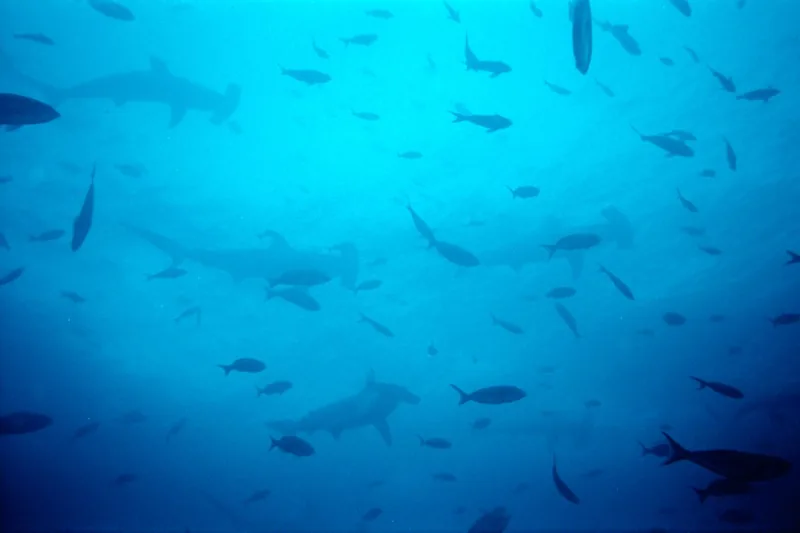 Photo: daren_ck (CC BY 2.0) via Wikimedia Commons
Galápagos is one of the best places in the world to see scalloped hammerheads, and the only reasonable way to say it is: schools of hundreds, sometimes in water you can see your watch in. They are the signature species of Darwin and Wolf, the far northern islands open only to dive liveaboards, with day-trip options from Santa Cruz for the determined.
Which hammerhead, and where
The scalloped hammerhead is the species here, and the Galápagos Marine Reserve is one of its global strongholds. Globally, though, the species is in trouble: the IUCN lists it as Critically Endangered (2020 assessment), with the worldwide population estimated to have declined by more than 80 percent over three generations, mostly to fishing pressure outside protected waters. The big schools gather around Darwin and Wolf, over 100 miles (160 km) northwest of Isabela, for reasons scientists still debate: the islands are tips of extinct undersea volcanoes rising half a mile (800 m) from the seafloor, and something about the position concentrates sharks.
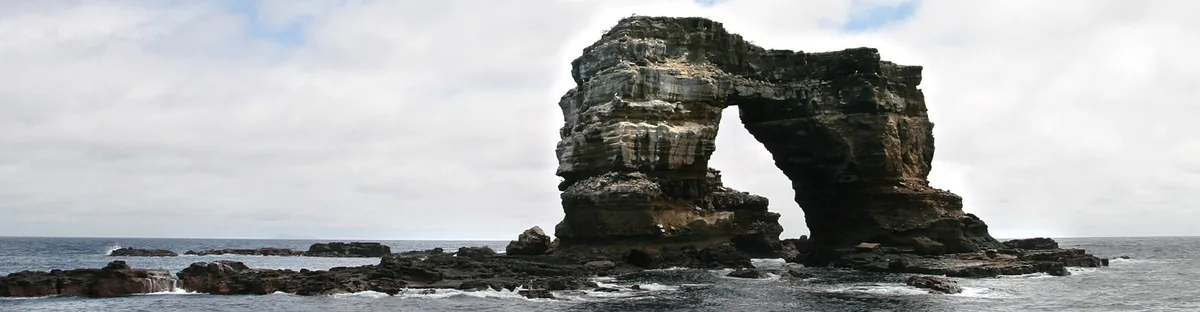
- Darwin and Wolf: the main event, reachable only on dive liveaboards, with strong currents and big walls.
- Gordon Rocks, off Santa Cruz: the classic day-trip site for certified divers, often with dozens in view.
- Kicker Rock, off San Cristóbal: snorkel and dive site with regular hammerhead encounters.
- Punta Mejía, Marchena: hammerheads alongside Galápagos sharks and eagle rays for liveaboard itineraries that get there.
January is arguably the best month at Darwin and Wolf, with warm water and good visibility; schools show up year-round, and the cold, nutrient-rich dry season concentrates everything that eats. Sharks are present all around the archipelago all year.
What they are doing down there
Hammerheads have electrical sensors spread across that wide head, which lets them sweep for prey buried in sand. They also have one of the largest brain-to-body ratios of any shark: they are sharp, and they are shy. Schools form by day, often near cleaning stations where small fish pick parasites off them, and scatter to hunt at night.
Courtship is blunt: males bite females until they submit, and females carry mating scars as standard. It looks brutal; biologists read it as a size-and-stamina test, and the females are thicker-skinned than the males, which is the whole evolutionary arms race in one line.
Safety, in real numbers
There have been no fatal shark incidents recorded in Galápagos, and only a handful of incidents of any kind since records began in 1854; one serious, non-fatal bite on a diver was reported in 2026. Hammerheads are timid around divers and usually keep their distance unless a current pushes the school past you. The real risk in these waters is current, not teeth.
How to actually do this
Hammerheads demand dive certification and current tolerance; this is not a first-dive species. If you are not a diver, Kicker Rock from San Cristóbal is your best snorkel shot, and Gordon Rocks needs at least 25 dives of experience according to most operators, so book a proper dive shop and be honest about your logbook. Liveaboards to Darwin and Wolf run week-long dive itineraries and sell out months ahead.
For the rest of the shark cast, our Galápagos sharks guide compares whitetip, blacktip, Galápagos and tiger sharks in one table. The whale shark shares Darwin and Wolf, and the rays of Galápagos round out the big-fish list.
Gordon Rocks, the day-trip version
For divers who cannot commit to a liveaboard, Gordon Rocks is where the hammerheads are. It is the eroded rim of a submerged volcanic crater off the north-east of Santa Cruz, about 45 minutes by boat from the Itabaca channel, with three pinnacles breaking the surface and walls dropping to 30 metres and more. The current runs through the crater, which is what brings the sharks and what makes the site demanding: operators ask for at least 25 logged dives and recent experience, and the briefing about hooking into the rock during the surge is not a formality. On a good day the schools pass above the wall in the blue, with Galápagos sharks, eagle rays, turtles and sea lions in between; on a quiet day you get the rays and the turtles and the sharks stay deep.
Day trips run two dives, usually both at Gordon Rocks or one at Gordon Rocks and one at a gentler site such as the Seymour channel, with lunch on the boat and a return to Puerto Ayora by mid-afternoon. From about US$150 to 200 with two tanks and lunch, it is the most affordable hammerhead dive in the islands.
Frequently asked questions
Where can I see hammerheads in Galápagos?
Darwin and Wolf on dive liveaboards for the big schools; Gordon Rocks off Santa Cruz as a certified-diver day trip; and Kicker Rock off San Cristóbal, where snorkellers often see them in the channel.
When is the best time to see hammerheads?
Year-round. January is often cited as the best month at Darwin and Wolf for warm, clear water and big schools; the cool season concentrates everything that eats.
Are hammerheads dangerous to divers?
No. They are timid around divers and keep their distance unless a current pushes the school past you. No fatal shark incident has ever been recorded in Galápagos; the real risk is the current.
Sources
- Biodiversity of Galápagos, Galápagos Conservancy
- Special Regulation for Tourism in Protected Areas (RETANP), Ministry of Environment (PDF)
- General visiting rules, Resolution 0000007 (Official Register 515), full text (PDF)
Last verified: October 2026