
Travel guide · Planning
Seasickness in Galápagos: the rough months, the calm boats and what to take
When the Galápagos sea gets rough and when it is calm, month by month; which boats and cabins move least; land-based options for seasick travellers; and what…
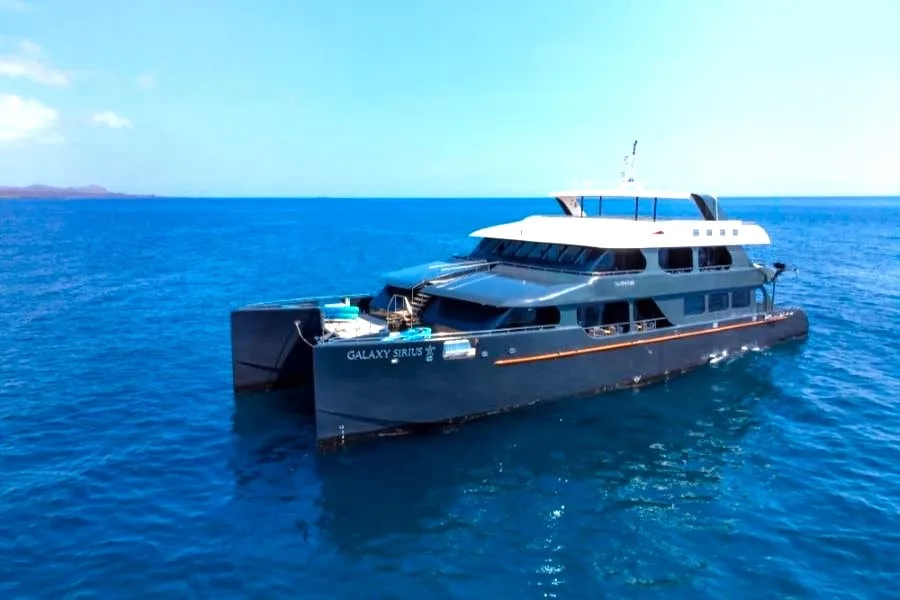
Galápagos sits in open ocean, 1,000 km from the mainland, and some crossings are bumpy. Nobody should skip the islands over it, but if you know your stomach, a little planning changes the trip. Here is when the sea moves, which crossings shake the most, which boats and cabins move least, how to see the islands with almost no open-water time, and what to take before you board.
When the sea is calm and when it is not
The calendar matters more than any remedy in your bag. From December to May the warm season brings the flattest water of the year; from June the south-east trade winds pick up and the Humboldt Current pushes cold water in; from July to October the sea is at its liveliest, with August and September at the peak. November settles again.
| Month | Sea state | Air °C (max/min) | Water °C |
|---|---|---|---|
| January | Calm, brief afternoon showers | 29 / 22 | 23–25 |
| February | Calm; the warmest month | 30 / 23 | 24–26 |
| March | Calm; occasional swell on north-facing coasts | 31 / 23 | 24–27 |
| April | Calm; best underwater visibility | 30 / 22 | 24–26 |
| May | Calm | 28 / 22 | 23–25 |
| June | Swell and currents begin as the trade winds arrive | 26 / 21 | 23–24 |
| July | Starting to get choppy | 24 / 20 | 22–23 |
| August | Choppy; strongest currents, swell on west and south coasts | 23 / 19 | 19–23 |
| September | The roughest month of the year | 24 / 19 | 20–23 |
| October | Still choppy; water starting to warm | 25 / 20 | 21–23 |
| November | Calming down; snorkel visibility improves | 26 / 21 | 22–24 |
| December | Calm | 27 / 22 | 23–25 |
Temperatures are the ranges operators and the IGTOA tour operators’ association publish, cross-checked with satellite sea-surface data; water readings vary by site and depth. If you are prone to seasickness, the first lever is simply to travel between December and May. Most of this page then becomes a footnote.
The crossings that actually get people
The inter-island ferries are the classic problem. They are speedboats carrying 20 to 40 passengers, they cross open water for 2 to 2.5 hours, and they run twice a day. Two facts worth knowing:
- The morning departures (06:00–07:00) are visibly calmer than the afternoon ones. The wind builds through the day, so the 15:00 boats take the chop.
- There is no direct San Cristóbal to Isabela boat. You change in Santa Cruz, a morning leg plus an afternoon leg. Expect it to eat the day.
Take your remedy about 30 minutes before departure, not when you already feel green. Sit at the back of the boat where the motion is smallest, keep your eyes on the horizon and stay outside if the crew allows it. The crews treat the crossing as routine because for them it is; for a first-timer in September it can be the worst two hours of the trip. Our ferry guide has the schedules.
Day tours from the towns cross open water too, but for shorter stretches: about an hour to North Seymour or Santa Fe, 45 minutes to Kicker Rock, and the longest, Bartolomé, around two hours each way from the Itabaca Channel. Morning departures, again, are the calmer ones.
Cruises do most of their navigation at night, while you sleep, which helps more than people expect: lying down flat is the best remedy there is. The long crossings are to the western islands (Isabela and Fernandina), to Genovesa in the far north, and to Española in the south; the central islands are a few hours apart.
If you are cruising: boat and cabin choices
A few things that make a real difference:
- Catamarans roll less. Two hulls give a wider, more stable platform, which is why many of the newer Galápagos yachts are catamarans. They can pitch in a head sea, but for most guests the difference is noticeable. Our catamarans vs monohulls guide lists which boats are which.
- Bigger, heavier boats move less. The 90–100 passenger ships are the steadiest platforms in the islands, and some carry stabilisers. A 16-passenger yacht feels every swell. The trade-offs are in small ship vs large ship.
- Lower, central cabins move less. A cabin on the lower deck, near the middle of the boat, moves far less than an upper-deck cabin at the bow. If you can choose, take the lower cabin and the smaller window.
- Ask the operator directly. “Does this boat have stabilisers, and where is my cabin?” is a fair question before you pay. We answer it for every boat we book.
- Western itineraries cross livelier water. The scenery is worth it, but it is the part of the trip where your remedies earn their place.
If you would rather not cruise at all
Land-based travel is the answer for people who know the sea is not for them: sleep ashore every night, pick day tours with short crossings, and skip the ferries entirely by basing yourself on one island. Santa Cruz alone fills five days with Tortuga Bay, the giant tortoise highlands, the Charles Darwin Research Station, Las Grietas and one or two morning boat trips. Isabela adds Concha de Perla, a snorkel lagoon you walk to from the dock, and the Sierra Negra hike. Our cruise vs land guide and the 5-day land-based itinerary show how to build it.
A middle path that works: a 4- or 5-day cruise on a catamaran in the calm season, central islands only, with a land stay on Santa Cruz before or after.
What to take
Talk to a pharmacist or your doctor before the trip, and test any medication at home first, because drowsiness on a snorkel day is its own problem.
| Remedy | How it is used | What to know |
|---|---|---|
| Scopolamine patch | Behind the ear, applied hours before sailing, lasts up to 3 days | Prescription in many countries; the strongest option for multi-day cruises; dry mouth is common |
| Dimenhydrinate, meclizine, cinnarizine | Tablet 30–60 minutes before the crossing | Over the counter in Ecuador (ask for “pastillas para el mareo”); most cause drowsiness |
| Ginger | Capsules, tea or candied | Mild, no drowsiness; good for the ferry if your seasickness is mild |
| Acupressure bands | Worn on the wrists | Opinions divide; they cost little, so bring them anyway |
Beyond drugs, the boring advice works: a light meal before boarding rather than an empty or full stomach, no alcohol the night before, eyes on the horizon, fresh air on deck instead of the cabin, and a seat low and mid-ship where motion is smallest.
Frequently asked questions
Which months are the roughest in Galápagos?
July to October, with August and September at the peak, when the Humboldt Current and the trade winds are strongest. December to May is the calmest period.
Are the Galápagos ferries rough?
They can be. The inter-island speedboats cross 2 to 2.5 hours of open water and the afternoon departures take the wind. Take the morning boat, sit at the back and take your remedy 30 minutes before boarding.
Which Galápagos boats are best for seasickness?
Catamarans and the larger ships, which roll less than small single-hull yachts. Within any boat, a lower-deck cabin near the middle moves least. Ask about stabilisers before booking.
Can I visit Galápagos without getting on a boat?
Almost. On Santa Cruz and Isabela you can fill several days with beaches, highlands, lagoons and snorkel sites reached on foot or by taxi. Any remote island needs a boat, but you can keep every crossing short and in the morning.
What is the best seasickness medicine for a Galápagos cruise?
That is a question for your doctor, but the scopolamine patch is the one most of our guests on multi-day cruises use, and over-the-counter tablets work for ferry days. Test whichever you choose at home first.
Related reading
The season tables and the wildlife by month are in best time to visit Galápagos; boat stability by hull type is in catamarans vs monohulls; and the ferry timetable is in getting between the islands.
Sources
- Weather and climate of the Galápagos, International Galápagos Tour Operators Association (IGTOA)
- Galápagos weather by month, Royal Galapagos
- Sea temperature at Puerto Ayora (NOAA satellite data), seatemperature.org
Last verified: October 2026