
Travel guide · Wildlife
Red-footed booby
The red-footed booby is Galápagos' most numerous booby and the easiest to miss. Colonies, tree nests, the 15-month cycle and when to visit Genovesa.
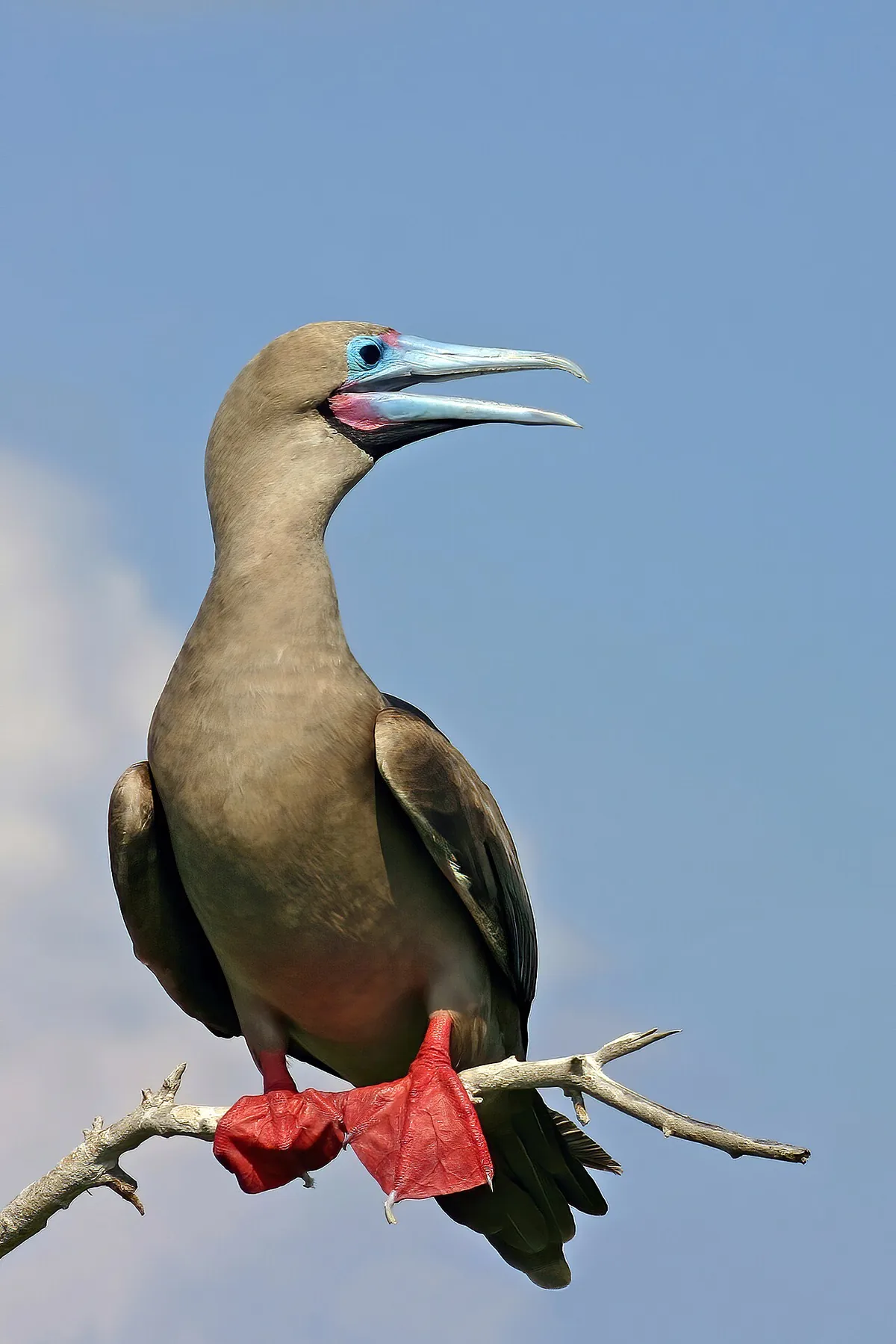 Photo: Charles J. Sharp (CC BY-SA 3.0) via Wikimedia Commons
The red-footed booby is the most numerous booby in Galápagos and, by a strange inversion, the one you are least likely to see. It nests on the outlying islands, partly feeds at night, and skips the central trails where the other boobies perform. If it makes your list, the plan is Genovesa, and this page tells you why.
Where to see them
Genovesa hosts the largest red-footed booby colony in the archipelago and one of the largest in the world; the global species population is far larger than most visitors assume, with BirdLife/IUCN estimating roughly 1.4 million mature individuals worldwide (2002 estimate, trend decreasing). Darwin Bay and the climb up Prince Philip Steps both pass nesting trees. The only other reliable colony is Punta Pitt on San Cristóbal, with occasional birds reported near Floreana and North Seymour. If your itinerary misses the far islands, this is one bird you may have to let go.
Why they are hard to find
Two habits keep them away from the crowds. First, they nest in trees and bushes, the only booby that does, so there is no ground colony in plain view. Second, they are semi-nocturnal and spend part of the night feeding in open water at the edge of the archipelago, which pushes them toward those remote islands in the first place.
What one looks like
This is the smallest of the three boobies, up to 77 cm tall against 90 cm for the blue-footed, with a wingspan reaching 145 cm. The feet are the famous red, the bill a pale blue, and the plumage brown in roughly 95 percent of birds. The red in the legs comes from carotenoids in their seafood, the same pigment logic that colors a flamingo.
A demanding commute
Red-footed boobies fly up to 90 miles (150 km) in a single foraging trip, which is one reason they need outlying colonies. Their nostrils close completely so they can hit the water from height without a lungful of sea, and they live past 20 years. One quirk from the trail: for all that long-distance skill, they take off badly in still air and wait for a breeze.
The slowest breeding cycle of the three
A pair raises one egg roughly every 15 months. Incubation takes around 45 days, and nesting activity runs from February to September depending on the island. Do not expect chicks everywhere at once; colonies on different islands are staggered.
Punta Pitt, the three-booby island
Punta Pitt on San Cristóbal is the only site in Galápagos where all three booby species nest side by side, alongside two frigatebird species. The trail climbs a tuff cone for about two hours, and it is the single best answer to “can I compare all the boobies in one morning?”
If the foot color race interests you, the blue-footed booby is its showiest contestant and the Nazca booby runs the grimmest sibling rivalry in the archipelago. For the rest of the bird cast, see our Galápagos birds guide and the wildlife calendar.
Two colour morphs, one species
Most red-footed boobies in Galápagos are brown: chocolate body, pale blue bill with a pink base, and the red feet that give the species its name. About five percent are white, with black flight feathers, and the two forms nest side by side in the same trees and pair with each other freely. The white morph is the common one elsewhere in the Pacific, which is why visitors who have seen the species in Hawaii or the Caribbean sometimes doubt the brown birds on Genovesa are the same animal. They are.
The bill colour is the quickest way to separate a red-footed booby from the other two at a distance. Nazca boobies have an orange bill and white plumage with a black mask; blue-footed boobies have a dull grey-green bill and streaky brown-and-white plumage. Add the habitat and the identification is done: a booby in a tree is a red-footed booby, because neither of the others nests above the ground.
Frequently asked questions
Where can I see red-footed boobies in Galápagos?
Genovesa, which holds the largest colony in the archipelago, and Punta Pitt on San Cristóbal, the only site where all three booby species nest together. Both are cruise sites.
Why are red-footed boobies hard to see?
They nest in trees and bushes on the outlying islands and feed partly at night far out at sea, so they skip the central ground colonies where the other boobies display.
How often do red-footed boobies breed?
About once every 15 months, raising a single egg. Incubation takes around 45 days and nesting runs from February to September depending on the island.
Sources
Last verified: October 2026