
Travel guide · Wildlife
Galápagos lava lizard
Around ten endemic species of lava lizard, where each lives, the pushup display and throat colors, and why you will see dozens of them on every trail.
 Photo: David Brito
The animal you will stop noticing by day three. Lava lizards are the small, everywhere reptile of the archipelago: around ten endemic species of Microlophus (counts run seven to ten depending on the authority; a new Gardner-islet species was described in 2024), one per island in most cases, dashing across trails, perched on iguana backs, and doing tiny pushups at each other. They are also a small lesson in how Galápagos builds species: 97% of the islands’ reptiles are endemic (galapagos.org), and the lava lizards are a textbook case, one species evolving per island.
Where to see them
Everywhere except three islands. Lava lizards live on all the main islands except Genovesa, Darwin and Wolf. One species is common across ten central and western islands; the others are island endemics, confined to Española, Floreana, Marchena, Pinta, Pinzón, San Cristóbal, Santa Fe and the Gardner islet. In practice:
- Any trail with lava rocks in the lowlands, from Puerto Egas to South Plaza, will produce sightings within minutes.
- Española has its own species, visible along the Punta Suárez trail with the albatross; the island detail is in our Española guide.
- Pinzón has its own species too, along with its recovering tortoise population.
- They are often seen darting between marine iguanas on shoreline rocks, sharing the basking spots. Fernandina’s Punta Espinosa is lizard-dense as well; the island’s other residents are in our Fernandina page.
When to see them
Year-round; cold-season mornings make them slower and easier to photograph. They are lowland animals, so coastal visitor sites beat highland ones. Breeding is spread through the year by island, but the display behavior below peaks in warm months.
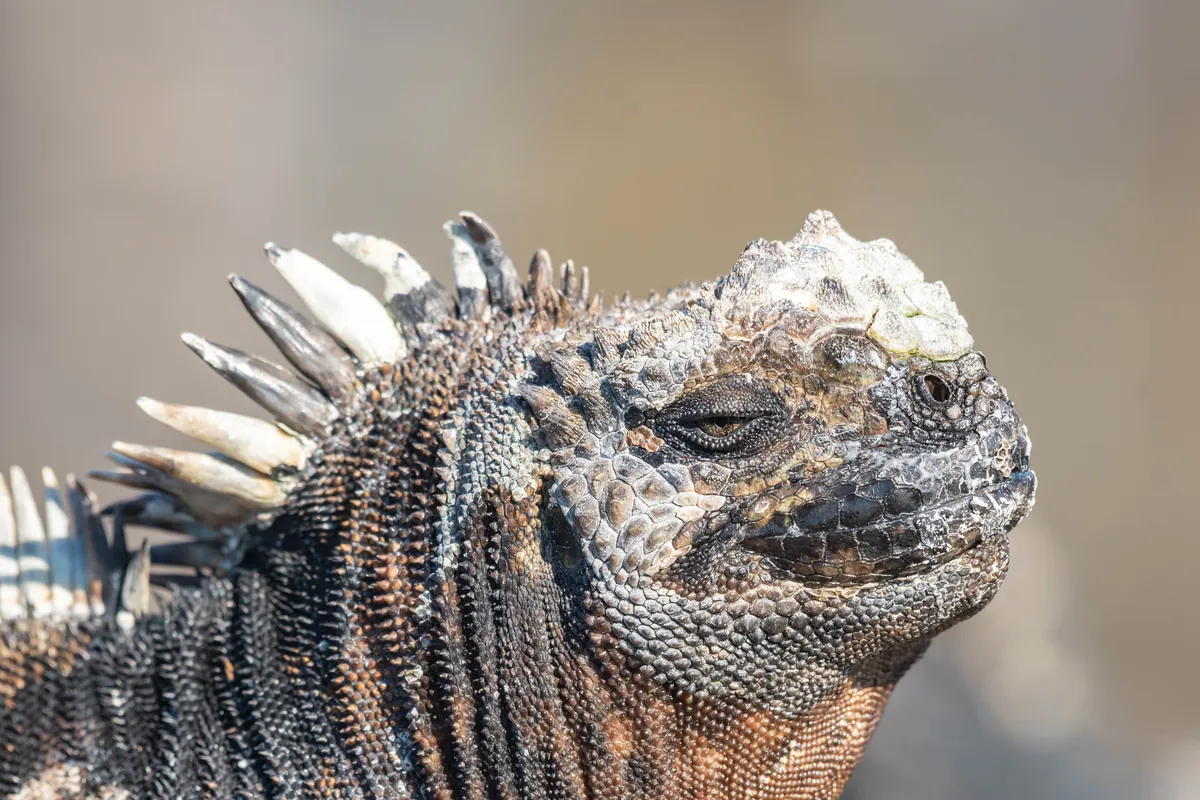
How to read one
- Size: 5–6 inches overall. Males are 2–3 times heavier than females and carry a crest along the back.
- Females: red throat and head, which makes sexing them trivial.
- Color: mottled grey through gold-and-black depending on species and ground; they can shift shade when threatened or when temperature changes suddenly.
- The pushups: a male’s territory can cover up to 400 m², and the pushup display is how neighbors negotiate. Escalation goes to tail-fights and bites when two males are evenly matched.
- Escapes: they can shed the tail to a predator and regrow it within weeks.
Conservation
Not listed as at risk, but population swings track El Niño cycles, which hit their insect and plant food hard in bad years. Their ecological job is pest control: they eat large numbers of the painted locust and other insects, and they themselves are prey for hawks, snakes, herons and mockingbirds. The threat to watch is the general one for small endemic reptiles: introduced predators on inhabited islands.
Details worth knowing
- Females lay 4–6 pea-sized eggs, with about three months of incubation.
- They control painted locust outbreaks; a lizard-heavy trail is a quieter trail.
- Darwin noted them, but the species split by island was worked out long after him, which is a common Galápagos pattern.
Watching the display
The pushup display is worth five quiet minutes on any trail. A male on a prominent rock raises his body on straight legs, bobs his head and does a set of pushups, and the pattern of bobs is specific to his species, which is how the island endemics stay separate where ranges touch. If a rival answers from the next rock, the exchange escalates: both animals flatten themselves sideways to look bigger, flare the throat, and circle. Most contests end there. The ones that do not end with a tail-lash and a bite, usually brief, because a lizard that loses a tail to a rival has lost its fat reserve as well as its balance.
Females display too, with their own shorter bobbing sequence, and a female in red-throated breeding colour on a male’s territory is what most of the summer activity is about. Early morning is the best time to watch, when the lizards have just warmed up and the males are reclaiming their rocks; by midday they retreat to shade and the show stops until the afternoon cools.
Frequently asked questions
How many species of lava lizard are there?
Around ten endemic species of Microlophus, counts run from seven to ten depending on the authority, with a new species from the Gardner islet described in 2024. Most islands have one species each.
How do I tell a male lava lizard from a female?
Females have a red throat and head; males are two to three times heavier and carry a crest along the back. The pushup display is a male’s territorial signal.
Where can I see lava lizards?
On almost any lowland trail with lava rock, from Puerto Egas to South Plaza. They live on every main island except Genovesa, Darwin and Wolf.
Sources
- A new lava lizard species from Gardner islet, Zootaxa (2024)
- Biodiversity of Galápagos, Galápagos Conservancy
Last verified: October 2026