
Travel guide · Wildlife
Galápagos land iguana
Where to see Galápagos land iguanas, the rescue story behind every population, and when to visit Cerro Dragón, North Seymour and South Plaza.
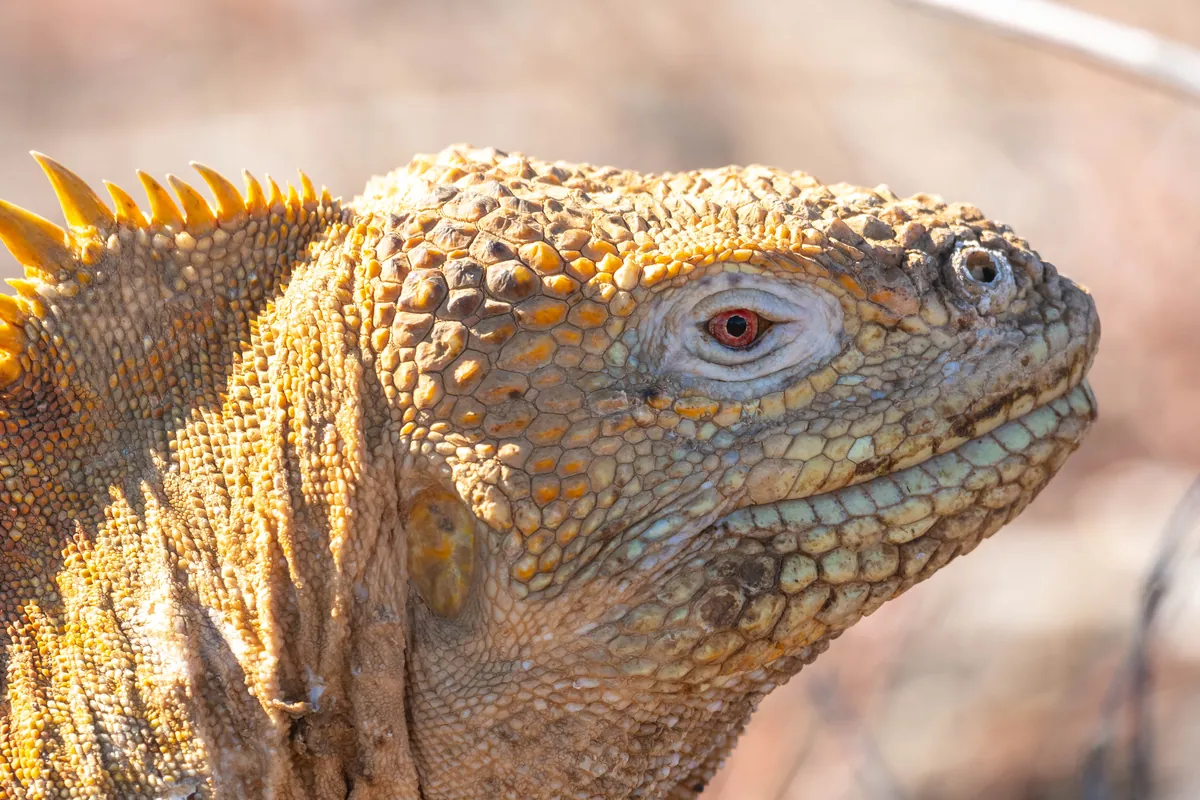 Photo: David Brito
A three-foot, thirty-pound yellow lizard that looks like something out of a storybook, and nearly became a cautionary tale. Land iguanas eat Opuntia cactus, live up to 50 years, and have spent two centuries losing ground to animals we brought: cats, dogs, pigs and rats. Most of the ones you will see trace back to rescue programs, which is part of why they are worth the walk.
Where to see them
- Cerro Dragón (Santa Cruz). In 1975 feral dogs wiped out almost the entire land iguana population in this part of northeast Santa Cruz. An emergency breeding program followed, the last captive-bred iguana was released here in 1991, and animals are still supplemented every few years. The lagoons behind the trail usually hold flamingos too.
- North Seymour. Land iguanas are not native here; naturalist Allan Hancock moved 70 from Baltra in the 1930s after US airmen had shot out Baltra’s population. The island now carries well over 2,500 of them (Baltra itself was repopulated with more than 3,000). With the 1.2-mile visitor trail, this is the most reliable iguana stop near the Baltra airport; the rest of the island is in our North Seymour guide.
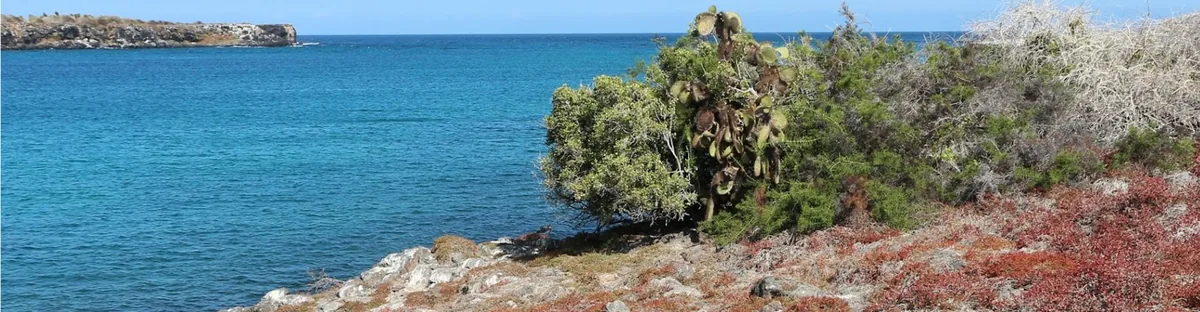
- South Plaza. The only place where land and marine iguanas share territory, and the occasional sterile hybrid shows up. The trail is 0.8 miles; details are in our South Plaza guide. The Sesuvium turns red in the dry season, which makes good iguana photos better.
- Isabela and Fernandina. Wild populations on Isabela’s volcanoes; Fernandina has its own subspecies. Pairing, which we mention below, peaks in January around these islands.
- Santa Fe. A separate species, Conolophus pallidus, paler and with a differently shaped head, unique to this island. It is one of only two species you cannot see anywhere else in its wild state (the other being the pink iguana, which has its own page); the Santa Fe guide covers the visit.
January 2019 brought the biggest single intervention: more than 1,400 iguanas from overcrowded North Seymour were released on Santiago, where Darwin had noted them abundant in 1835 and where none had lived in over a century. The move also eased food pressure on North Seymour’s cactus stands. The Isabela populations went through their own bottleneck in the 1970s and were kept going by an emergency rescue program.
When to see them
Year-round, though midday heat sends them into shade and burrows, so morning visits are better. Their rhythm is slow on purpose: deliberate movement conserves body heat, they sleep in self-dug burrows at night, and May sees land iguana births on Santa Cruz. Pairing season on Isabela runs around January, covered in our January page.
Conservation
Conolophus subcristatus and the Santa Fe species C. pallidus are both listed Vulnerable by the IUCN; the genus totals somewhere between 5,000 and 10,000 animals across the archipelago. Decline since Darwin’s visit is driven almost entirely by introduced species, and the population is well below historical levels. The recovery playbook is now proven: remove the predators or move the iguanas, breed if needed, release, and monitor. The 1970s rescue program is what saved them, and the Cerro Dragón and Santiago releases show the model still working. If you are planning around specific sites, our national park rules page covers the distance and trail rules that apply to every iguana visit.
Details worth knowing
- They grow past 3 feet and 30 lb, and live up to 50 years in the wild.
- They are almost purely herbivorous: Opuntia pads, fruit and flowers. On South Plaza some climb the cacti; everywhere they wait under trees for ripe pads to drop, which is faster than climbing.
- The Galápagos mockingbird sometimes rides on their backs, picking ticks.
- Hybrids with marine iguanas occur only at South Plaza: gray and sterile, and rare at that.
Frequently asked questions
Where can I see land iguanas in Galápagos?
North Seymour, a day trip from Santa Cruz with well over 2,500 animals; Cerro Dragón on Santa Cruz; South Plaza, where they share territory with marine iguanas; and Santa Fe, which has its own paler species.
Why were land iguanas moved to Santiago?
Because North Seymour, where they had been introduced in the 1930s, was overcrowded, and Santiago had lost its own iguanas a century earlier. More than 1,400 were released there in January 2019.
What do land iguanas eat?
Mostly Opuntia cactus: pads, fruit and flowers. They wait under the cacti for ripe pads to drop, which is faster than climbing, though on South Plaza some climb anyway.
Sources
- Genetics and conservation of Galápagos land iguanas, PLOS ONE 2019 (PubMed Central)
- Biodiversity of Galápagos, Galápagos Conservancy
Last verified: October 2026