
Travel guide · Wildlife
Galápagos dove
The Galápagos dove, Near Threatened and found only here. Where it thrives, the Genovesa pollination story, and how to tell it from a common ground dove.
 Photo: Bernard Gagnon (CC BY-SA 3.0) via Wikimedia Commons
A stocky, pink-washed ground dove with a down-curved bill, endemic to the archipelago and easier to hear than to notice: its low cooing carries across every arid trail. It is one of the quiet stars of island evolution, because on Genovesa it does a job that bees do everywhere else on Earth. Listed Near Threatened, it is worth knowing before your first walk through the cactus zone.
Where to see them
Doves are widespread through the drier lowlands:
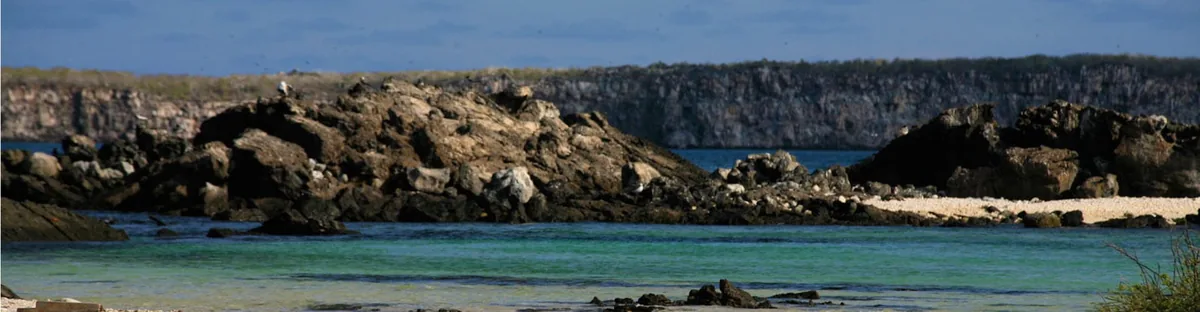
- Genovesa. The showcase island: doves are abundant, approachable, and tied to the Opuntia story below. El Barranco and Darwin Bay trails both deliver them.
- North Seymour. Common along the visitor trail, often at eye level in the Opuntia stands; access is a short hop from Baltra (see our North Seymour guide).
- Santa Fe and Pinzón. Regular sightings; Pinzón’s doves share the island with its recovering tortoises.
- The inhabited islands’ arid zones, including the Tortuga Bay trail on Santa Cruz, though they are shyer where people and feral cats are established.
- Darwin and Wolf hold a distinct larger, darker subspecies you will only glimpse from liveaboard routes.
When to see them
Year-round, with breeding timed to the first rains: nesting usually starts weeks after January’s rains begin, and a pair can raise up to three broods in a good year. Nests sit on the ground or in old mockingbird nests in cactus, with two eggs and young flying at about two and a half weeks. Early morning is the active window; by midday they rest in shade.
The Opuntia partnership
On most islands, bees pollinate the Opuntia cactus. Genovesa has no bees, and over time the cactus spines there softened, allowing the dove to feed on pulp, nectar and fruit, pollinating the plant and spreading its seeds. It is one of the cleanest examples in Galápagos of two species reshaping each other. The bill is curved specifically for foraging seeds and berries off the ground.
Conservation
Near Threatened; sources differ on whether the trend is stable or slowly declining. Historically sailors shot them for food because they were so tame they perched on outstretched hands (early settlers’ reports say they landed on heads). The modern threat is the one that runs through every Galápagos ground-nester: feral cats, which prey on adults and chicks, plus habitat pressure near settlements. The population is not in crisis, but the trend line matters, and ground-nesting birds have the least margin for error.
Details worth knowing
- 18–23 cm long, up to 88 g, with red legs and a blue-gray crown that separates it from the related, much smaller and paler ground dove of the mainland.
- They excavate for food: a dove can shift its own body volume of soil in five minutes, work that would take a human six-plus hours at the same rate.
- Ground nesters use a broken-wing distraction display to lure predators away from chicks.
- They get most of their water from cactus pulp, which is why they concentrate around Opuntia stands in the dry season.
Telling the dove from its relatives
Two things separate the Galápagos dove from any dove you have seen before. The first is the face: a bright blue ring of bare skin around the eye, set off by a dark line below it, which no mainland dove in the region carries. The second is the shape of the bill, longer and curved downward for digging, which gives the head a slightly hunched, purposeful look as the bird walks. The body is compact and reddish-brown, with black-and-white scalloping on the wings and pink on the breast that deepens in the breeding season; the legs and feet are red.
The mainland species that reaches the islands, the eared dove, is larger, greyer and plainer, and it keeps to the towns and farms. Any dove you meet on a lava trail, in the arid zone or on an uninhabited island is the endemic. Listen too: the call is a low, two-part coo that carries a long way across the scrub, and on Genovesa it is often the first sound after the panga engine stops.
Frequently asked questions
Where is the best place to see the Galápagos dove?
Genovesa, where it is abundant and tied to the Opuntia cactus it pollinates, and North Seymour, often at eye level in the cactus stands. It is also common in the arid zones of Santa Fe, Pinzón and the inhabited islands.
Is the Galápagos dove endangered?
It is listed as Near Threatened; sources differ on whether the trend is stable or slowly declining. Feral cats on the inhabited islands are the main pressure on this ground-nesting bird.
How do I recognise a Galápagos dove?
By the blue ring of bare skin around the eye, the down-curved bill, red legs and the reddish-brown body with scalloped wings. The mainland eared dove is larger, greyer and keeps to the towns.
Sources
Last verified: October 2026