
Travel guide · Islands
Daphne Major: the island where evolution was watched, and why you can’t land
Daphne Major, the Galápagos islet where the Grants watched evolution happen in Darwin's finches for 40 years: the study, the geology, why landings are…
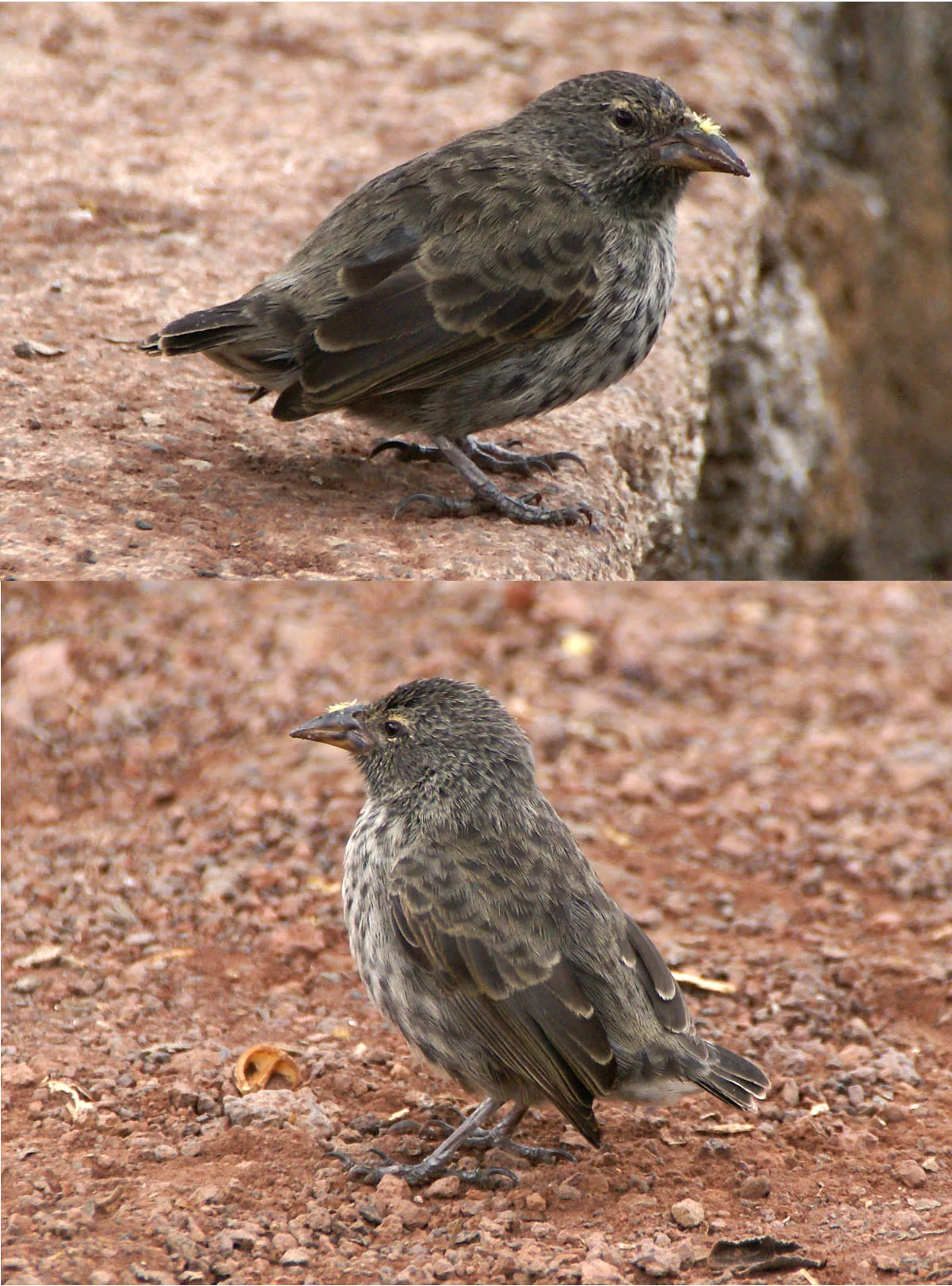 Photo: putneymark (CC BY-SA 2.0) via Wikimedia Commons
Daphne Major is a barren, treeless volcanic cone rising about 120 metres out of the sea between Santa Cruz and Baltra, and it may be the most important small island in the archipelago for a reason that has nothing to do with tourism. For four decades, two biologists camped on its crater floor and measured every finch on it, and in doing so watched evolution happen in real time. You cannot land there. You can sail past it, see it from the plane window on the Baltra approach, and dive its neighbour, and for many trips out of Baltra you will.
Key facts
| Where | About 8 km north of Santa Cruz, west of Baltra, in the central archipelago |
| What it is | An eroded tuff cone with two craters; roughly 0.3 km² and 120 m high; the smaller Daphne Minor sits a few kilometres away |
| Access | Closed to visitors. Landings require a scientific permit from the Galápagos National Park; there is no trail, dock or beach |
| Why it matters | Site of the longest field study of evolution in action: Peter and Rosemary Grant’s research on Darwin’s finches, 1973 to 2012 |
| How to see it | From the air on the approach to Baltra, from boats heading to North Seymour, Bartolomé or Santiago, and on dives at Daphne Minor |
The finch study that put Daphne on the map
In 1973 Peter and Rosemary Grant, then at McGill University and later at Princeton, chose Daphne Major because it was small enough to know every bird on it, isolated enough that few birds arrived or left, and untouched enough that nothing human interfered. For the next 40 years they returned every season, caught, banded and measured each finch, and recorded what it ate, who it bred with and whether it survived.
The island delivered. In 1977 a drought killed most of the plants; the small, soft seeds disappeared first, and only the medium ground finches with the largest, deepest beaks could crack the tough seeds that remained. Most of the population died, the survivors had measurably bigger beaks, and so did their chicks the following year. Natural selection had changed a species in a single generation, and the Grants had measured it. The wet El Niño years of the 1980s pushed the average back the other way. Then, in 1981, a single large cactus finch flew in from Española, 100 km away, bred with a local bird, and its descendants, nicknamed the “Big Bird” lineage, bred only among themselves. By 2017 the Grants and their colleagues described them as the beginnings of a new species, formed on an island in a few generations.
The work earned the Grants the Royal Medal, the Kyoto Prize and the Balzan Prize, and gave Jonathan Weiner’s book “The Beak of the Finch” (1994) a Pulitzer. For a reader of Darwin it closed a loop: the finches Darwin collected in 1835 and barely understood became, on this one rock, the best-documented example of evolution anywhere on Earth.
What lives there
Daphne Major is a seabird colony first. Blue-footed boobies nest on the flat floor of the larger crater, one of the densest booby colonies in the islands, and Nazca boobies on the rim. Red-billed tropicbirds nest in the cliff crevices, magnificent frigatebirds patrol overhead, and in the sparse scrub of palo santo and Opuntia cactus live the finches that made the island famous: the medium ground finch, the cactus finch and, since the 1980s, the Big Bird lineage. Marine iguanas and sea lions use the rocks at the waterline. Nothing on the island is bigger than a booby, and nothing has ever been introduced, which is precisely the point.
Why you cannot visit
The park’s position is simple: the value of Daphne Major is a finch population that has been watched for half a century and seabird colonies that nest on the ground, and tourism on an island this small would put both at risk. Access is by scientific permit, and even researchers climb a cliff to get ashore. Several other islands are closed as well; our guide to getting your bearings explains which ones and why, and the national park rules explain the system of visitor sites that keeps the rest open.
How to see it anyway
- From the plane. Flights into Baltra often pass Daphne Major on the approach. Sit on the left for a look at the crater, though the pilot does not take requests.
- From the water. Day boats from the Itabaca Channel to North Seymour and Bartolomé pass close by, and cruises leaving Baltra round the island on their way north or west. Guides tell the finch story from the deck.
- Underwater. Daphne Minor is a day-dive site out of Puerto Ayora, with walls, schooling fish, eagle rays and the occasional hammerhead; some itineraries also list a panga ride or snorkel along Daphne Major’s cliffs. Our diving guide covers the day-boat options.
- The finches themselves. You do not need Daphne to see Darwin’s finches. Eight of the thirteen species live in the Santa Cruz highlands around Los Gemelos, and every inhabited island has several species in town. The Darwin’s finches guide explains how to tell them apart.
Frequently asked questions
Can you visit Daphne Major?
No. Daphne Major is closed to tourism; landings are allowed only for scientists with a permit from the Galápagos National Park. You can see it from boats passing between Baltra, North Seymour and Santiago, and from the plane on the Baltra approach.
Why is Daphne Major famous?
Because Peter and Rosemary Grant studied its Darwin’s finches there every year from 1973 to 2012 and documented natural selection changing beak size within single generations, as well as the birth of a new finch lineage. It is the best-documented example of evolution in action.
Where is Daphne Major?
In the centre of the archipelago, about 8 km north of Santa Cruz and just west of Baltra, where the airport is. Daphne Minor, the smaller cone, lies a few kilometres further away.
Can you dive at Daphne?
Daphne Minor is a recognised day-dive site from Santa Cruz, known for its walls, eagle rays and schooling fish. Daphne Major’s cliffs appear on some cruise itineraries as a snorkel or panga stop; there is no landing either way.
What is the difference between Daphne Major and Daphne Minor?
Daphne Major is the larger cone with two craters and the finch study; Daphne Minor is a smaller, more eroded cone nearby, used as a dive site. Neither allows landings.
Related reading
The island sits in the middle of every trip that uses Baltra airport: see Baltra vs San Cristóbal for how arrivals work, and cruise vs land for whether a boat is the right way to see the central islands.
Sources
- Peter R. Grant and B. Rosemary Grant, “40 Years of Evolution: Darwin’s Finches on Daphne Major Island”, Princeton University Press, 2014
- Lamichhaney, Grant et al., “Rapid hybrid speciation in Darwin’s finches”, Science, 2018
- Galápagos Conservancy: the islands
Last verified: October 2026