
Travel guide · Wildlife
Galápagos mockingbird
Four endemic mockingbird species, one per island group, and the birds that convinced Darwin. Where to see each one, and the blood-drinking Española record.
 Photo: David Brito
Before the finches, there were the mockingbirds. Darwin collected them in 1835 and noticed that each island’s birds differed, which was the observation that cracked his thinking open; the finches got the fame, but the mockingbirds were the first evidence. Four endemic species live in the archipelago, and seeing all four is a proper birding project, because three of them are island-locked and one is critically endangered.
Where to see them
- Galápagos mockingbird (Mimus parvulus), the common one, on every major island except San Cristóbal, Floreana and Española. You will meet it on Santa Cruz trails, at North Seymour, and around Isabela’s visitor sites.
- San Cristóbal mockingbird, on San Cristóbal, including the El Junco highlands and the La Galapaguera area.
- Española mockingbird (the Hood mockingbird), on Española, the boldest bird in the archipelago and the star of the strangest behavior below.
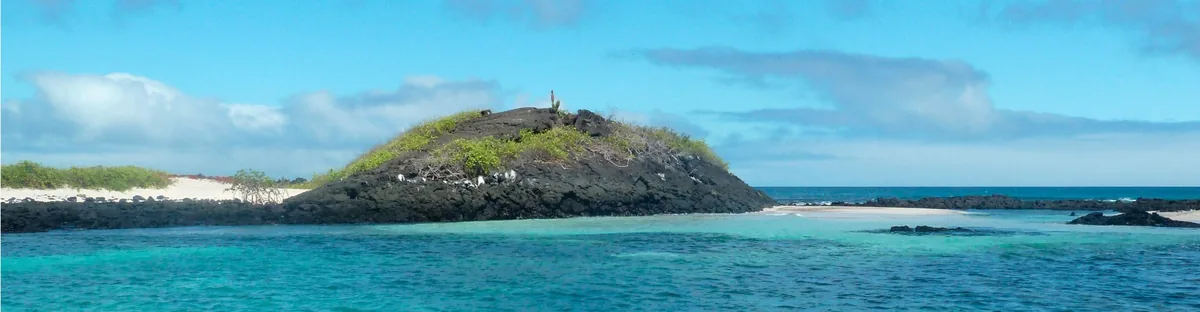
- Floreana mockingbird, the rarest, gone from Floreana itself and surviving only on two small offshore islets, Champion and Gardner, with a population estimated at 350–500 individuals. You cannot land there; some itineraries sail close enough for guides to point the islets out, and seeing one from a boat is a legitimate lifer.
- Santa Fe’s birds belong to the common species but are noticeably bolder around visitors.
When to see them
Year-round. They nest in trees and cacti but spend most of their time running on the ground through cover, so walking any arid-zone trail produces sightings. The first rains of the warm season (December–January) bring song and breeding, when they are most vocal and easiest to find.
The behavior list
- Curiosity over fear. They approach you to inspect you rather than flying off. This is standard island-evolution naivety and the reason the park enforces distance rules (rules here).
- Mimicry. The common name is literal: they copy calls of other species.
- The Española record. Hood mockingbirds have been seen drinking blood from wounds on living iguanas, and they ride on the backs of marine iguanas picking ectoparasites. Neither behavior is typical of the other three species; the island’s other residents are in our Española guide.
- The iguana alarm network. Marine iguanas recognize the mockingbird’s alarm call and react to it. The favor is one-way: iguanas have no equivalent call, so the mockingbird gets an early warning system it does not return.
- Diet. Omnivorous and opportunistic: insects, seeds, carrion, and whatever falls from your lunch if you are careless.
Conservation
The common mockingbird is not under threat and is thriving. The other three carry the risk that island endemism always brings: the Floreana mockingbird is Endangered (downlisted from Critically Endangered in 2017), the Española species is Vulnerable, and the San Cristóbal species is Endangered. Each depends on the feral-cat and rat situation of its island. The Floreana story has a live update: the 2023–2024 rat and cat eradication on Floreana is the first step toward returning the species to its island (one of 12 locally extinct species queued for reintroduction), and the islet birds are the natural remnant populations that survived after the Floreana birds vanished in the 1880s.
Why the mockingbirds convinced Darwin first
Darwin collected mockingbirds on four islands in 1835 and, unlike with the finches, labelled where each came from. Back on the Beagle he noticed that the birds from Floreana, San Cristóbal and Santiago differed from one another in plumage and size, and that each island seemed to hold its own kind. In his notes from the voyage he wrote that if the differences held, they would undermine the stability of species, the first recorded crack in his thinking. The finches got the fame later, once the ornithologist John Gould sorted them in London; the mockingbirds were the evidence Darwin saw for himself, island by island.
That is still the pattern you can watch today. The common species on Santa Cruz is slightly smaller and paler than the Española bird, which is bulkier and bolder with a longer, more curved bill; the San Cristóbal species has darker streaking; and the Floreana bird, now confined to its islets, is the most distinct of the four. Four islands, four answers to the same question, which is the archipelago’s whole argument in one genus.
Frequently asked questions
How many mockingbird species live in Galápagos?
Four, all endemic: the common Galápagos mockingbird on most islands, and one each on San Cristóbal, Española and Floreana. The Floreana species survives only on the Champion and Gardner islets.
Do mockingbirds really drink blood?
The Española (Hood) mockingbird does, from wounds on living iguanas and sea lions, and it rides on marine iguanas picking parasites. The other three species do not.
Why do mockingbirds approach people?
Island naivety: they evolved with no land predators and inspect anything new, including you. It is the reason the park enforces the two-metre rule, and why you should never feed them.
Sources
- Together for Floreana, Charles Darwin Foundation
- Restoring Floreana, Galápagos Conservation Trust
- Biodiversity of Galápagos, Galápagos Conservancy
Last verified: October 2026