
Travel guide · Wildlife
Green sea turtle
Green sea turtles in Galápagos, the only nesting marine turtle here. Nesting and hatching seasons, best beaches, and why hatchlings face 1-in-1,000 odds.
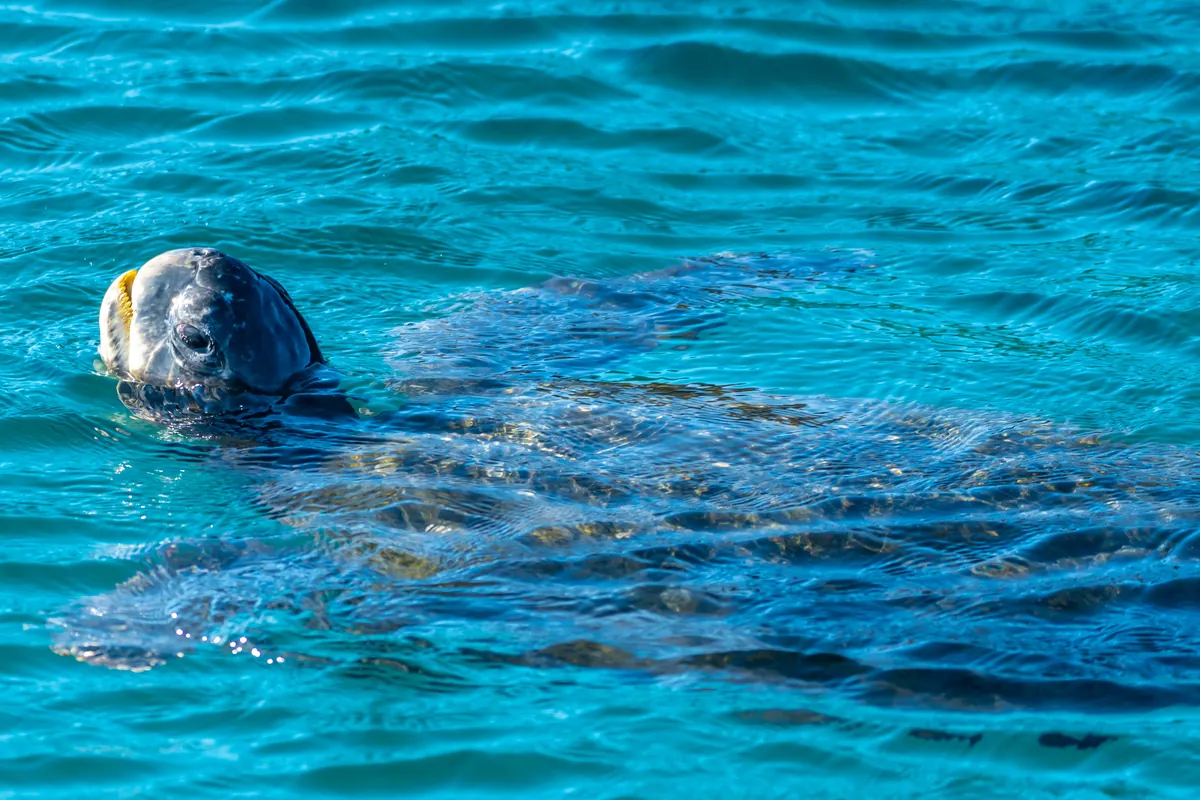 Photo: David Brito
The green sea turtle is the only marine turtle that nests in Galápagos, and it is the animal most likely to accompany your snorkel: grazing in the shallows, surfacing next to your panga, gliding past at Kicker Rock. Globally it was reclassified from Endangered to Least Concern by the IUCN in 2025, after four decades listed as Endangered; the Galápagos nesting population remains small and fully protected. Here is where and when to see them, and what the nesting season looks like.
Where to see them
Two beaches dominate the nesting: Las Bachas on Santa Cruz and Punta Cormorant on Floreana. Turtles feed in the calm mangrove coves of Black Turtle Cove and Tortuga Bay, graze off Isabela, and nap on reefs almost everywhere. In season you will find them mating in open water and, at night, females hauling out to lay.
The nesting calendar
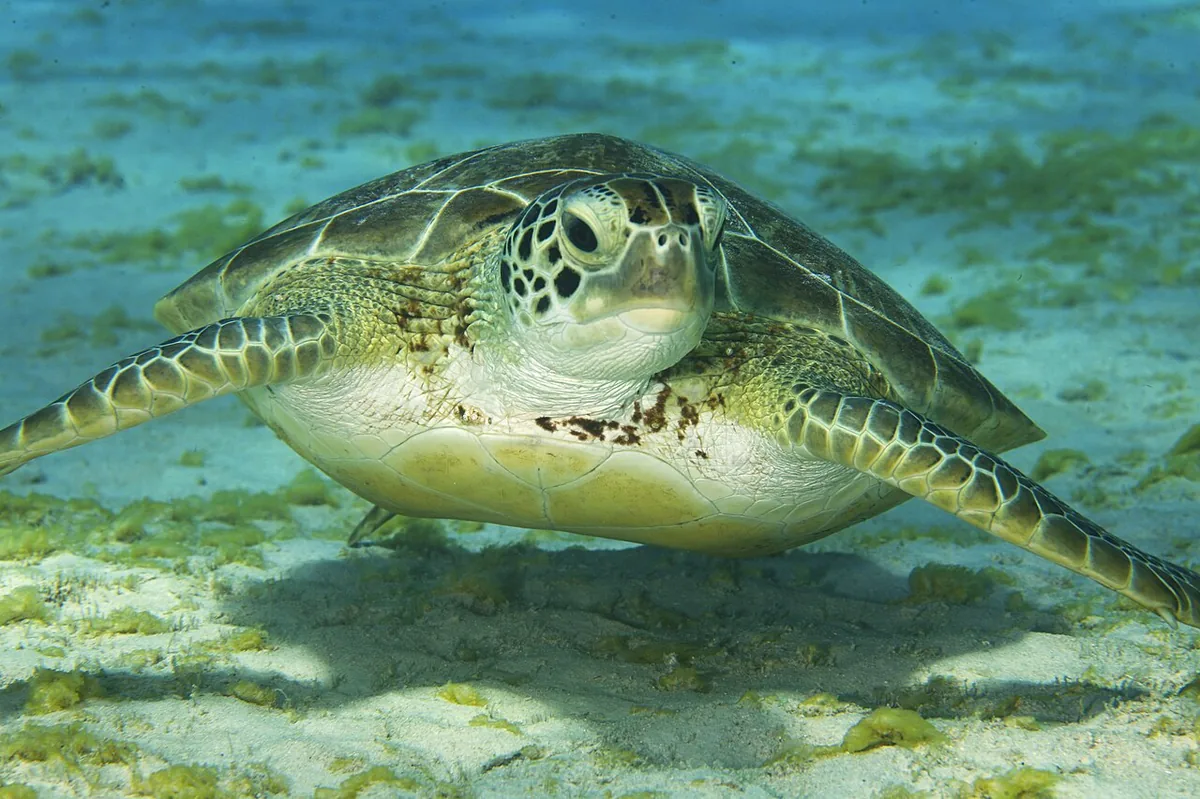
Courtship and mating peak from November to January, and nesting runs from January through March, with the first females ashore in January. A female lays roughly 100 eggs per nest (clutches of 110 or more are exceptional for the species), in a hole she digs at night, and leaves flipper tracks in the sand as the obvious clue for morning walkers. On Floreana the nesting season stretches from December to May.
Hatching follows about two months later, from April into June, and the hatchlings race to the surf at night. The often-cited estimate is that roughly one hatchling in 1,000 reaches adulthood; introduced predators take a heavy toll on nests, and hatchlings are confused by lights from boats and buildings.
Built for the long game
An adult can measure up to 1.5 m and weigh over 200 lb (90 kg), with the biggest specimens past 280 lb (130 kg). Sexual maturity arrives absurdly late, at 26 to 40 years, and females return to the beach where they hatched to nest themselves. They are strong swimmers for their bulk, moving in bursts up to 30 mph (50 km/h) when they need to.
The name is odd until you learn the reason: the algae in their diet tint their body fat green. And that salty lifestyle requires plumbing: a gland behind each eye excretes excess salt, which looks exactly like the turtle is crying.
Snorkeling with them
Turtles are calm and completely uninterested in you, which is the point: keep two meters, never block a surfacing turtle’s path to air, and never touch. The best snorkels for turtles are Black Turtle Cove, Tortuga Bay’s inner lagoon, Kicker Rock and Los Túneles. A turtle surfacing to breathe is the most common “wow” moment on a first-timer’s trip, and it never gets old.
Why they matter beyond the beach
Turtles are grazers that keep seagrass and algae healthy, and their nesting beaches feed everything from crabs to hawks. Because they nest only here in the archipelago, the local population is a single, fragile system: protect the beaches, and the whole cycle works. The National Park controls access to the main nesting beaches, and guides time landings around it.
For their nesting neighbors, see our sea lion page; for the sharks that share their waters, the sharks guide; for the season-by-season rundown, the wildlife calendar.
Reading the tracks on the beach
An early walk on a nesting beach in season tells the night’s story in the sand. A green turtle’s track is a broad band about a metre wide with symmetrical flipper marks on either side, because she pulls herself up with both front flippers at once, which separates it from the alternating marks of other species. The track up the beach ends at a wide, churned area where she dug the body pit and the egg chamber, usually above the high-tide line among the dune plants; the return track runs straight back to the water, often shorter and more direct. A single set of tracks means a nest; two sets side by side can mean a female that came up, found the sand wrong and went back without laying.
Guides will show you the signs without walking onto the nest area, and the rule for visitors is the same: stay on the wet sand below the tide line, never dig or probe, and keep lights off the beach at night, because a hatchling’s instinct is to run toward the brightest horizon, which should be the sea.
Frequently asked questions
When do green turtles nest in Galápagos?
From January to March, with the first females ashore in January; on Floreana the season stretches from December to May. Hatchlings emerge from April to June.
Where can I snorkel with turtles?
Black Turtle Cove and Tortuga Bay’s inner lagoon on Santa Cruz, Kicker Rock off San Cristóbal, Los Túneles off Isabela and Concha de Perla. Turtles are calm and ignore snorkellers who keep two metres.
Is the green turtle endangered?
Globally it was reclassified from Endangered to Least Concern by the IUCN in 2025 after decades of protection. The Galápagos nesting population remains small and fully protected.
Sources
- Green turtle assessment (2025), IUCN Red List
- Biodiversity of Galápagos, Galápagos Conservancy
- Visiting rules, Galápagos National Park Directorate
Last verified: October 2026